If you’re wondering how long to smoke ribs at 225°F, plan on about 4½–5½ hours for baby back ribs, 5–6 hours for St. Louis-style ribs, and roughly 5–7 hours for full spare ribs.
But the clock should never be your only measure of doneness.
Rack thickness, rib type, smoker temperature, wrapping, weather, and even the individual pig can change the cook time. The best way to know when ribs are finished is to combine approximate cooking time with the bend test, probe or toothpick tenderness, bone exposure, and internal temperature.
Here’s how to get it right.
How Long to Smoke Ribs at 225°F: Quick Chart
Use these times as planning ranges rather than exact deadlines.
| Rib Type | Approximate Time at 225°F |
|---|---|
| Baby back ribs | 4½–5½ hours |
| St. Louis-style ribs | 5–6 hours |
| Full spare ribs | 5–7 hours |
A thick rack may take longer. A smaller rack may finish sooner.
Wrapped ribs also tend to cook faster than ribs left exposed for the entire cook.
The important rule: start checking for tenderness before the expected finish time rather than automatically pulling the ribs because the clock says five hours.
Why Rib Type Changes Cooking Time
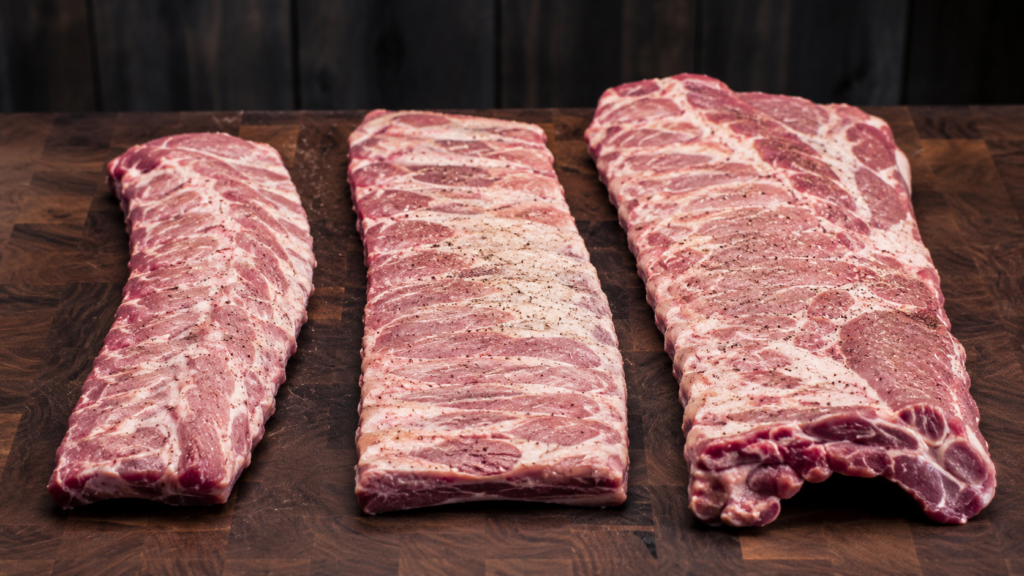
Not every rack of pork ribs is built the same.
Baby Back Ribs
Baby backs come from the upper portion of the rib cage near the loin. They are shorter, curved, and generally leaner than spare ribs.
Because they are usually smaller and contain less connective tissue, baby backs tend to finish sooner.
At 225°F, I would begin checking baby backs for tenderness at around the 4-hour mark and expect most racks to finish somewhere around 4½–5½ hours.
St. Louis-Style Ribs
St. Louis ribs begin as spare ribs but are trimmed into a more uniform rectangular rack.
They contain more fat and connective tissue than baby backs and typically need additional time for that connective tissue to soften.
Plan on approximately 5–6 hours at 225°F.
Full Spare Ribs
Full spare ribs are larger and include portions normally removed when trimming a rack into the St. Louis cut.
They can vary considerably in size and thickness.
A large rack may easily require 6 hours or longer at 225°F, so don’t be surprised if your spare ribs push toward the upper end of the 5–7 hour range.
If you’re deciding which cut is best for your cook, check out our complete guide to Baby Back vs Spare Ribs.
How to Tell When Smoked Ribs Are Done
This is where a lot of backyard cooks get into trouble.
Ribs don’t have one magic internal temperature that automatically means they are perfect.
Temperature is useful, but texture should make the final decision.
I like to use several signs together.
The Bend Test
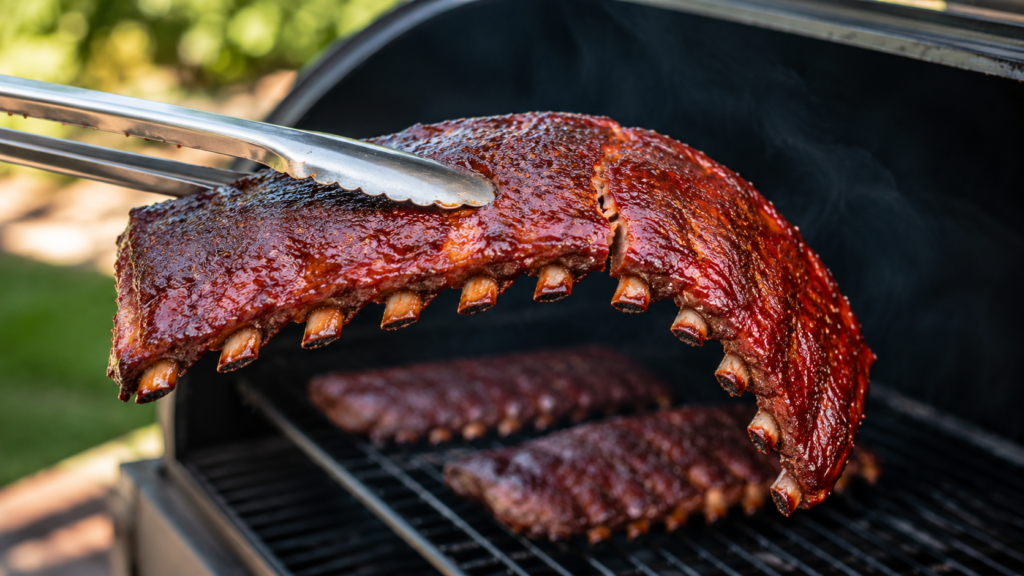
The bend test is one of the simplest ways to check a full rack of ribs.
Grab the rack with a pair of tongs roughly one-third of the way from one end and gently lift it.
A properly cooked rack should bend noticeably under its own weight. You may also see the surface of the bark begin to crack where the rack bends.
If the rack remains stiff, it probably needs more time.
If it practically breaks apart when you pick it up, you’ve probably gone beyond competition-style tenderness.
The Toothpick or Probe Test
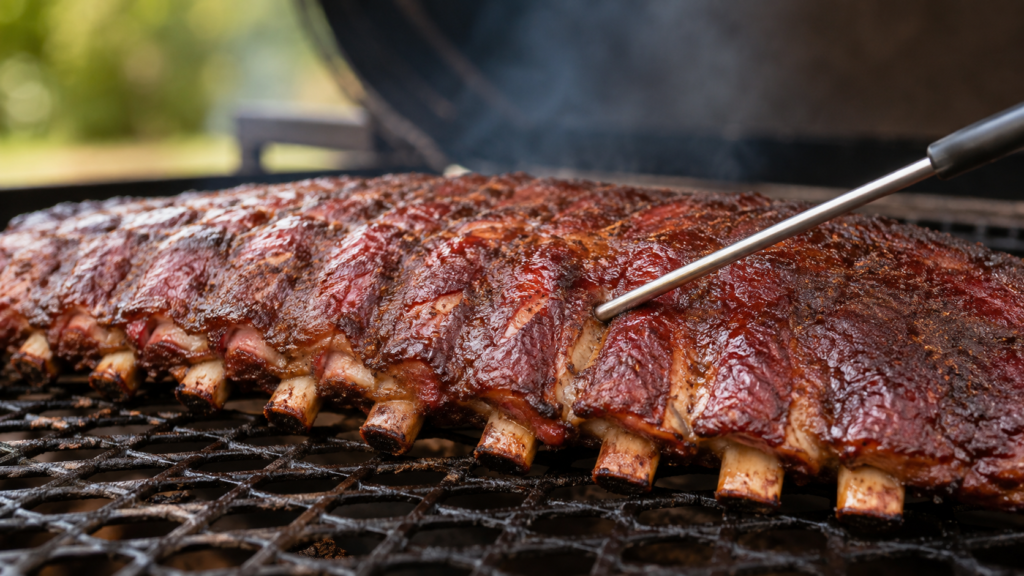
This may be my favorite test because it tells you directly how tender the meat has become.
Slide a toothpick, skewer, or thin instant-read thermometer probe into the meat between two bones.
You should feel very little resistance.
Think about the difference between sticking a toothpick into a raw potato versus softened butter. You’re looking much closer to the butter end of the spectrum.
Test several areas of the rack because the thickness may not be completely uniform.
Our Temperature Probe Placement guide shows exactly where to position a thermometer in ribs and other common BBQ cuts.
Look for Bone Exposure
As ribs cook, the meat will often shrink slightly away from the ends of the bones.
Seeing approximately ¼ inch or more of exposed bone can be another indication that you’re getting close.
Don’t use bone exposure alone, though.
Different racks pull back differently, and a rack can show exposed bones before it reaches the tenderness you want.
What Internal Temperature Should Ribs Be?
Internal temperature is useful as supporting information, but ribs are difficult to measure accurately because there isn’t much meat between the bones.
Ribs commonly become tender somewhere around 190–205°F internal temperature.
That is a range—not a target.
If your ribs read 198°F but still feel tight when you probe between the bones, keep cooking.
If they’re beautifully tender and pass the bend test at 195°F, don’t keep cooking just because you’re chasing 203°F.
This is very different from simply checking the temperature of a pork chop or steak.
And because accurately measuring thin meat can be difficult, a good instant-read thermometer is extremely helpful. See our guide to the Best BBQ Thermometers if you need one.
Should You Wrap Ribs at 225°F?
You don’t have to wrap ribs.
Both methods work.
What changes is primarily time, bark, moisture, and texture.
Wrapped Ribs
Wrapping ribs in aluminum foil traps heat and moisture around the meat.
That can:
- Speed up the cook
- Soften the ribs faster
- Reduce moisture loss
- Produce a softer bark
Foil produces the strongest steaming effect.
Butcher paper breathes more than foil, although foil is much more common when cooking ribs.
Unwrapped Ribs
Leaving ribs unwrapped allows the bark to remain exposed throughout the cook.
You’ll generally get:
- Firmer bark
- Less steaming
- A slightly longer cook
- More opportunity to control the final texture
Neither method is automatically better.
If you’re cooking on a deadline or prefer very tender ribs, wrapping can help.
If bark and a slightly firmer bite matter more, leaving them unwrapped may be the better approach.
For a deeper look at the tradeoffs, read Wrap vs No Wrap BBQ.
How Long to Smoke Baby Back Ribs at 225°F
For baby backs, I would plan on approximately 4½–5½ hours at 225°F.
Here’s a simple approach.
Smoke the ribs bone-side down and leave them alone for the first few hours. Once the bark has developed and the ribs begin showing some pullback from the bones, start paying closer attention.
At approximately four hours, begin checking tenderness.
If wrapping, your total cook may fall toward the shorter end of the range. If cooking a thick rack completely unwrapped, it may take longer.
Once the rack bends easily and a probe slides between the bones with very little resistance, you’re done.
If you want the complete process from trimming and seasoning through smoking and saucing, follow our BSL Smoked Baby Back Pork Ribs recipe.
Want Ribs Faster? Try Party Ribs
You don’t always have five or six hours available.
That’s where party ribs become interesting.
Instead of smoking the rack whole, party ribs are sliced into individual ribs before cooking.
That creates more exposed surface area for seasoning and smoke while allowing heat to reach each rib from several directions.
The result is a much faster cook with a completely different presentation.
They’re particularly good for:
- Football parties
- Tailgates
- Appetizers
- Large gatherings
- Game-day BBQ
You also get seasoning and sauce around almost the entire rib instead of only the outer surfaces of a full rack.
If time is tight, check out our Smoked Party Ribs technique.
Smoking Ribs at 225°F vs 250°F vs 275°F
Do ribs have to be smoked at 225°F?
Absolutely not.
225°F is simply a traditional low-and-slow cooking temperature that gives connective tissue plenty of time to soften without aggressively cooking the exterior.
Here is how the three common smoking temperatures compare.
| Smoker Temperature | What to Expect |
| 225°F | Slowest cook, very forgiving, classic low-and-slow approach |
| 250°F | Slightly faster while still providing excellent control |
| 275°F | Faster cook, great when time matters, requires closer attention near the finish |
Smoking Ribs at 225°F
225°F works especially well when you aren’t in a hurry.
The downside is time.
A temperature fluctuation of 10–15 degrees also isn’t a reason to panic. Your smoker does not need to sit at exactly 225°F every second of the cook.
Smoking Ribs at 250°F
I consider 250°F a very comfortable middle ground.
You shorten the cook somewhat without dramatically changing the low-and-slow process.
For backyard BBQ, there’s nothing wrong with running ribs at 250°F.
Smoking Ribs at 275°F
275°F is useful when you want ribs finished faster.
You can still produce excellent ribs, but you’ll want to begin checking tenderness sooner because the window between done and overdone becomes smaller.
The lesson?
Don’t obsess over 225°F. Control your fire, understand your ribs, and cook until they’re tender.
Common Mistakes When Smoking Ribs at 225°F
Relying Entirely on Time
This is the biggest mistake.
A recipe saying “cook five hours” doesn’t know how thick your rack is, how accurate your smoker thermometer is, or whether you wrapped your ribs.
Use time to decide when to start checking, not when to automatically remove the meat.
Using Too Much Smoke
More smoke isn’t always better.
You want clean combustion and clean smoke.
Heavy, dirty smoke can leave ribs bitter and overpower everything you put into the seasoning.
Let the pork, rub, smoke, and sauce work together.
Opening the Smoker Constantly
Every time you open the lid, heat escapes.
You’ll also make it harder to understand how your smoker behaves because you’re constantly changing the cooking environment.
Check when you actually need to check.
Otherwise, leave the lid closed.
Wrapping Too Early
Don’t wrap simply because a timer tells you to.
Give the surface time to develop color and bark first.
Wrapping too early can trap moisture against the ribs before the exterior has developed the texture you want.
Cooking Until the Meat Completely Falls Off the Bone
There’s nothing wrong with preferring very soft ribs.
Cook them however you and your family enjoy them.
But traditionally, properly cooked BBQ ribs should still have enough structure that you can pick up a rib and take a clean bite from the meat.
If the bones literally slide out of the rack and the meat falls apart like pulled pork, you’ve moved beyond that traditional rib texture.
The goal is tender—not mushy.
Helpful Gear for Smoking Ribs
You don’t need a collection of expensive BBQ gadgets to smoke good ribs, but a few tools make the process easier.
Instant-Read Thermometer
Useful for checking several areas between the bones near the end of the cook and testing tenderness at the same time. Here’s one I use.
Leave-In Temperature Probe
Helpful for monitoring your smoker’s grate temperature and identifying large temperature swings without constantly opening the cooker. Here’s the one I use.
Rib Rack
A rib rack can help when cooking several racks on a smaller smoker by positioning them vertically and freeing up grate space. If space is a concern use a vertical stand. Here’s the 2 I use.. 5 Racks or 3 Racks.
Heavy-Duty Aluminum Foil
If you prefer wrapped ribs, use heavy-duty foil. Standard thin foil tears easily on exposed rib bones.
Butcher Paper
Useful if you want some of the benefits of wrapping while allowing more moisture to escape than with foil. Use Butcher Paper.
Spritz Bottle
A simple food-safe spray bottle works well if your cooking method includes an occasional spritz of apple juice, diluted apple cider vinegar, or another liquid. Here’s the bottle I use.
Heat-Resistant BBQ Gloves
Ribs become awkward to move late in the cook, particularly when wrapping or unwrapping hot racks. Heat-resistant gloves make handling them considerably easier. Two different types: Fire Resistant or Nitrile gloves with cotton liners.
Final Thoughts: How Long Should You Smoke Ribs at 225°F?
For planning purposes, expect approximately:
- Baby back ribs: 4½–5½ hours
- St. Louis ribs: 5–6 hours
- Full spare ribs: 5–7 hours
But don’t let the clock cook your ribs.
Start checking early.
Look for the rack to bend easily. Check for cracking in the bark. Look for some pullback around the bones. Slide a toothpick or probe between the bones and pay attention to resistance.
Internal temperature can help confirm what you’re seeing, but tenderness ultimately tells you when the ribs are ready.
Long cooks also make reliable pellet quality important. Keep your pellets dry and protected so moisture doesn’t affect feeding or combustion. Here’s how to protect your wood pellets…👉 Here.
That’s the difference between following a timer and actually learning how to barbecue.
Frequently Asked Questions
Can you smoke ribs at 225°F without wrapping them?
Yes. Ribs can be smoked from start to finish at 225°F without wrapping. Expect the cook to take somewhat longer, but you’ll generally preserve a firmer bark. Begin checking for tenderness near the lower end of the expected cooking-time range.
Is 225°F or 250°F better for ribs?
Both temperatures work well. 225°F provides a slower, very forgiving cook, while 250°F can shorten cooking time without dramatically changing the finished ribs. There is no need to maintain exactly 225°F to make great barbecue.
What temperature are ribs fall-off-the-bone?
There isn’t one exact internal temperature that guarantees fall-off-the-bone ribs. Ribs frequently become tender in roughly the 190–205°F range, but time at temperature, wrapping, rack thickness, and connective-tissue breakdown all affect texture. Use temperature together with a physical tenderness test.
How long do ribs take at 225°F in a pellet smoker?
The same general ranges apply: roughly 4½–5½ hours for baby backs and 5–7 hours for larger spare ribs. Pellet smokers vary in airflow and actual grate temperature, so monitor the cooking environment and judge final doneness by tenderness.
Can ribs stay at 225°F too long?
Yes. Low temperature does not make ribs impossible to overcook. Leave them on long enough and the meat can eventually become overly soft, dry, or mushy. Begin checking tenderness before the expected finish time.
🔥 Shop BSL Favorites on Amazon!
📄 Get Free BBQ Recipes, Guides & Charts
👉Check out the list of BBQ Gear I recommend and use
🔥 Follow Backyard Smoke Lab for more BBQ tips, recipes, and reviews
📺 YouTube: https://www.youtube.com/@backyardsmokelab
📸 Instagram: https://www.instagram.com/backyardsmokelab
🎵 TikTok: https://www.tiktok.com/@backyardsmoklab
🌐 Website: https://backyardsmokelab.com