


You’re hours into a cook. The smoker is humming along at 250°F. Your brisket climbs steadily to 150°F internal… then 155°F… then 160°F…
And then it just stops.……
Thirty minutes pass.
An hour passes.
Maybe two.
You check your thermometer. You check your smoker. You question your life choices.
Welcome to the stall — one of the most misunderstood (and panic-inducing) phases of barbecue.
In this complete guide, we’ll break down:
- What the BBQ stall actually is
- Why it happens (the real science)
- When it starts and how long it lasts
- Whether you should wrap or wait it out
- How to manage the stall on pellet, offset, charcoal, or drum smokers
- Common mistakes that ruin cooks
This is foundational BBQ knowledge — and once you understand it, you’ll never stress during a long cook again.
What Is the BBQ Stall?
The BBQ stall is a period during low-and-slow cooking when the internal temperature of meat stops rising for an extended time, usually between:
It can last:
- 1–2 hours on smaller cuts
- 3–5+ hours on large briskets or pork butts
During this phase, the meat may appear “stuck,” even though your smoker temperature is steady.
But here’s the key:
👉 Your meat isn’t broken. Your smoker isn’t broken. This is physics.
Why the Stall Happens (The Science Made Simple)
The stall is caused by evaporative cooling.
Let’s break that down in plain language.
As meat cooks:
- Muscle fibers tighten.
- Moisture is pushed toward the surface.
- That moisture evaporates.
- Evaporation cools the meat — just like sweat cools your body.
When evaporation happens at the same rate as heat is entering the meat, the temperature plateaus.
This is identical to:
- Sweat cooling your skin
- Water evaporating off pavement
- A damp towel staying cool in the sun
Your smoker may be 250°F, but the surface evaporation keeps the internal temperature locked in place temporarily.
Eventually:
- Surface moisture reduces
- The bark sets
- Evaporation slows
- Internal temperature starts rising again
That’s when you “break through the stall.”
When Does the Stall Start?
Most commonly:
- Brisket: 150–165°F
- Pork Butt: 155–170°F
- Ribs: Sometimes minor stall, usually less noticeable
- Whole Chicken/Turkey: Rarely stalls significantly
The stall is most pronounced on:
- Large, fatty cuts
- Thick muscle mass..Pork Butts and Packer Briskets
- Low cooking temperatures (225–250°F)
How Long Does the Stall Last?
There’s no fixed clock.
It depends on:
- Size of the cut
- Fat content
- Cooking temperature
- Humidity inside the smoker
- Airflow
Typical ranges:
| Cut | Average Stall Duration |
|---|---|
| 8 lb Pork Butt | 1–3 hours |
| 15 lb Brisket | 2–5 hours |
| Ribs | 30–90 minutes |
The lower your pit temperature, the longer the stall may last.
This is why cooks at 225°F often experience longer stalls than those running 250–275°F.
The Three Ways to Handle the Stall
You have three main options.
1️⃣ Wait It Out (Traditional Method)
Pros:
- Best bark formation
- Maximum smoke exposure
- Pure traditional technique
Cons:
- Takes longer
- Requires patience
If time is not a factor, this method produces incredible bark and flavor.
2️⃣ The Texas Crutch (Wrap It)
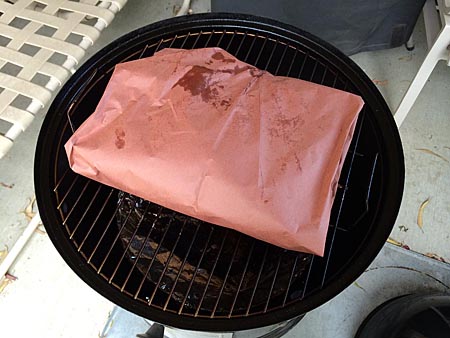

Wrapping the meat tightly in:
- Butcher paper (breathable)
- Aluminum foil (full seal)
This traps moisture and stops evaporative cooling. 👉 Here’s my article on Wrap vs No Wrap
Pros:
- Powers through stall faster
- Shortens cook time
- Helps retain moisture
Cons:
- Softens bark slightly (foil more than paper)
- Slightly reduces smoke contact
Paper preserves bark better than foil.
3️⃣ Increase the Temperature
Instead of wrapping, raise your smoker from:
- 225°F → 250°F or 275°F
This pushes more heat energy into the meat to overcome evaporative cooling. Although I recommend this is only used as a last resort. By the time your smoker adjusts the stall may be over.
Pros:
- Maintains bark
- No wrapping required
- Shortens stall time
Cons:
- Slightly less “low and slow” purist method
Many competition cooks run brisket at 275°F today — the stall is much shorter.
Wrap vs No Wrap: Which Is Better?
There is no universal “best.”
It depends on your goal:
- Want deep bark? → Don’t wrap.
- On a time crunch? → Wrap.
- Cooking overnight? → Wait it out.
- Want balance? → Wrap in butcher paper.
If you’re new to smoking:
👉 Wrapping reduces stress and improves consistency.
If you’re chasing elite bark texture:
👉 Practice patience.
👉 Here’s my article on Wrap vs No Wrap
Does the Stall Mean the Meat Is Drying Out?
No. This is a common misconception.
During the stall:
- Collagen is breaking down.
- Fat is rendering.
- Connective tissue is softening.
This process is what transforms tough brisket and pork shoulder into tender BBQ.
The stall is not drying your meat out — it’s part of tenderization.
Check out my article Why Is My Brisket Tough? 7 Common Causes and How to Fix Them
Should You Open the Lid During the Stall?
No. Every time you open the smoker:
- Heat escapes.
- Humidity drops.
- The stall can extend longer.
Trust your thermometer.
Let the smoker do its job.
Pellet Smokers vs Offset vs Charcoal: Does It Change?
The stall happens on every type of smoker, including:
- Pellet grills
- Offset stick burners
- Kamado cookers
- Drum smokers
- Gravity fed charcoal smokers
However:
- Pellet smokers tend to have slightly higher airflow → stall can feel longer.
- Kamados retain humidity better → stall sometimes shorter.
- Offsets fluctuate more → stall may appear inconsistent.
But the physics remain the same.
Internal Temperature vs Feel: What Really Matters
The stall usually ends around:
- 170–180°F internal
But don’t cook by temperature alone.
For brisket and pork butt:
- Final doneness is around 195–205°F
- What matters is probe tenderness — it should feel like warm butter.
The stall is just a mid-cook checkpoint.
How to Plan Around the Stall
Here’s the golden rule:
👉 Start earlier than you think you need to.
Large cuts can take:
- 1–1.5 hours per pound at 250°F
Always allow:
- Extra stall time
- 1–2 hours resting time
If it finishes early?
Wrap it in towels and hold in a cooler (faux cambro). It will stay hot for hours.
Common Stall Mistakes
❌ Cranking heat to 350°F in panic
This can toughen bark and disrupt rendering.
❌ Constant lid opening
Extends the stall.
❌ Assuming thermometer failure
The stall is normal — verify with a second probe if unsure.
❌ Pulling meat at 170°F
This is mid-cook, not done.
The Psychological Side of the Stall
The stall is where beginners lose confidence.
You start doubting:
- Your temperature
- Your smoker
- Your method
Experienced pitmasters smile when the stall hits.
Because they know:
The best barbecue always comes after it.
Pro Tips for Managing the Stall
- Run 250–275°F for more predictable timing.
- Use a reliable digital thermometer.
- Wrap at 165°F if cooking on a schedule.
- Rest your meat at least 1 hour after cooking.
- Don’t slice brisket immediately — let juices redistribute.
Final Thoughts: Embrace the Stall
The BBQ stall isn’t a problem.
It’s a milestone.
It’s proof that:
- Collagen is breaking down.
- Fat is rendering.
- Real barbecue is happening.
The stall is what separates grilling from true low-and-slow smoking.
Next time your meat “stops cooking,” relax.
Grab your favorite drink!
Trust the process.
Let the physics work.
Because on the other side of the stall?
That’s where the magic happens.
Check out my [Beginner’s Guide to Smoking]. Not sure which BBQ Smoker is right for you.. We’ll break it down Here!
🔥 Shop BSL Favorites on Amazon!
📄 Get Free BBQ Recipes, Guides & Charts
👉Check out the list of BBQ Gear I recommend and use
🔥 Follow Backyard Smoke Lab for more BBQ tips, recipes, and reviews
📺 YouTube: https://www.youtube.com/@backyardsmokelab
📸 Instagram: https://www.instagram.com/backyardsmokelab
🎵 TikTok: https://www.tiktok.com/@backyardsmoklab
🌐 Website: https://backyardsmokelab.com