
Learning how to buy a griddle is about more than choosing the model with the largest cooking surface or highest advertised heat output. The right outdoor griddle should match how many people you normally feed, what you want to cook, where you plan to store it, and how much maintenance you are willing to do.
A good flat-top griddle can handle breakfast, smash burgers, cheesesteaks, fajitas, fried rice, vegetables, seafood, and complete family meals. However, differences in cooking-surface construction, burner layout, heat control, grease management, frame quality, and warranty can make one griddle much easier to own than another.
This outdoor griddle buying guide explains the most important features to compare before spending your money.
Quick answer: For most families, a freestanding propane griddle with three independently controlled burners and approximately 28 to 30 inches of cooking width provides the best combination of capacity, temperature control, and manageable size.
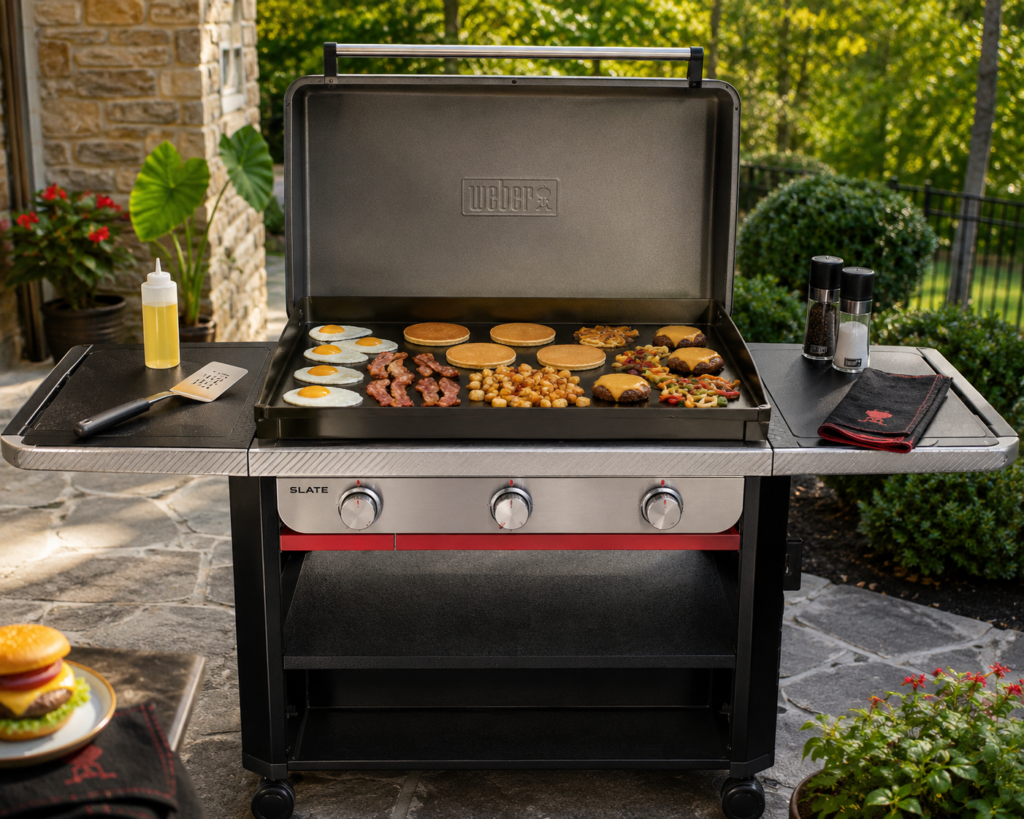
1. Decide What You Want to Cook
Before comparing brands, decide how you plan to use your griddle.
Someone who primarily cooks pancakes, eggs, bacon, and burgers for four people has different needs from someone who regularly prepares fried rice or cheesesteaks for a large group. A larger cooking surface gives you room to separate raw and cooked ingredients, but it also takes longer to clean and requires more patio space.
Outdoor griddles are especially useful for foods that are difficult to cook on traditional grill grates. Small vegetables, chopped meat, eggs, loose hash browns, and fried rice stay on the solid surface instead of falling between the grates.
Think about the meals you realistically expect to cook rather than buying the largest model simply because it looks impressive.
2. Choose the Right Griddle Size
Griddle size is normally described by the width of the appliance or the total square inches of cooking area.
Small tabletop griddles in the 17- to 22-inch range work well for camping, tailgating, apartments, and cooking for two to four people. They are portable and relatively easy to store, but their limited cooking space can become frustrating when preparing several foods at once.
Freestanding griddles between approximately 28 and 30 inches are usually the sweet spot for families. They provide enough room to cook multiple ingredients while remaining reasonably easy to move, cover, and maintain.
Larger 36-inch griddles make sense for entertaining, large families, meal preparation, or anyone who regularly cooks for a crowd. The tradeoff is a larger footprint, greater fuel use, and more surface area to clean.
When measuring your patio, account for the griddle body, side shelves, lid clearance, propane tank, and enough working room around the appliance.
3. Compare the Number of Burners
The number of burners affects more than maximum heat. It determines how much control you have over separate cooking zones.
A single-burner griddle heats the entire surface at approximately the same setting. That may be adequate for a compact tabletop model, but it limits your ability to cook different foods simultaneously.
Two burners allow you to create a hot side and a cooler side. Three burners provide even more flexibility and are ideal for a medium-sized family griddle. You can sear burgers over high heat, cook onions over medium heat, and keep finished food warm over low heat.
Four-burner models provide excellent zone control across a large surface but may be unnecessary for smaller households.
Look for independently controlled burners positioned to distribute heat evenly across the griddle. Uneven burner spacing can create noticeable hot and cold areas. Burner distribution, portability, maintenance, and adjustable support are among the primary considerations suggested when comparing flat-top griddles.
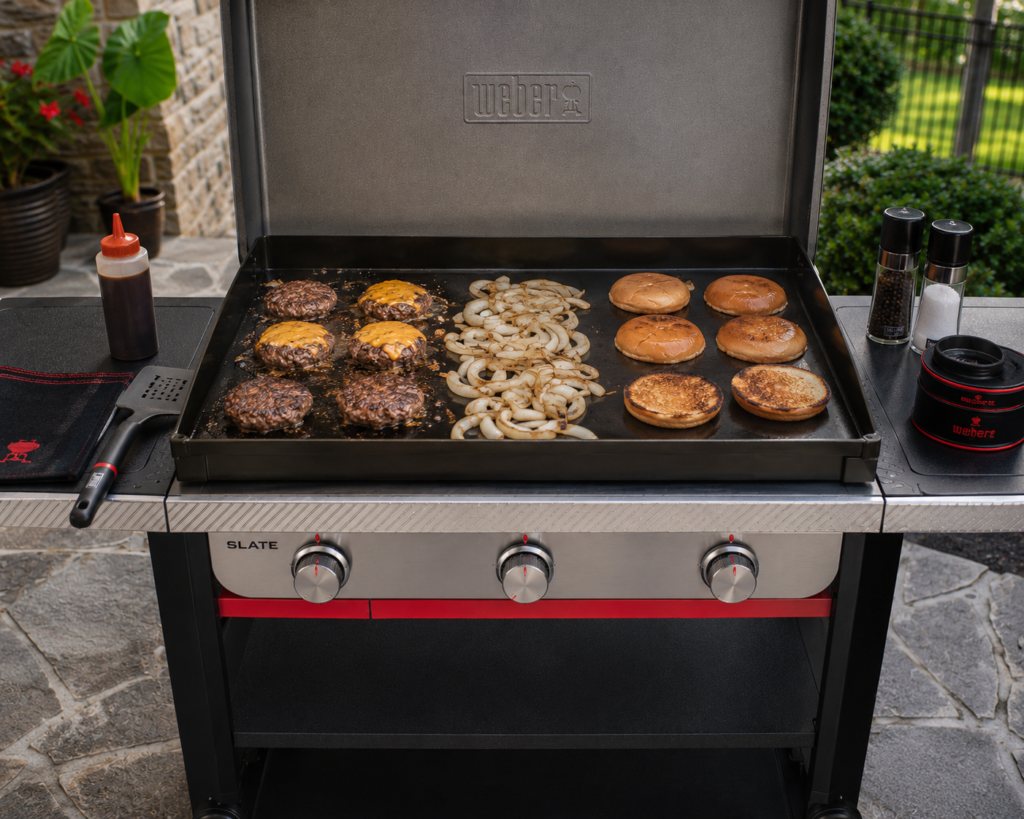
4. Examine the Cooking-Surface Material
Most traditional outdoor griddles use carbon steel or rolled steel. These materials can handle metal spatulas, high heat, scraping, and repeated seasoning.
A seasoned steel cooktop develops a darker surface over time. That seasoning helps protect the metal and creates an increasingly stick-resistant cooking area. However, standard steel griddles must be cleaned, dried, lightly oiled, and protected from moisture to reduce the chance of rust.
Some electric griddles use ceramic or other nonstick coatings. These are convenient and require less seasoning, but they may restrict the use of metal tools and can be less suitable for aggressive scraping.
Do not assume that every surface marketed as “rust-resistant” is completely rust-proof. Even a premium cooktop benefits from proper cleaning, a light protective layer of oil, a hard lid, and a weather-resistant cover.
Look for a cooking surface that feels substantial and sits securely on the frame. A heavier cooktop generally retains heat better when cold food is added, although the overall burner design remains equally important.
5. Look Beyond the BTU Number
BTUs measure potential heat output, but a higher number does not automatically mean a better griddle.
Cooktop thickness, burner placement, wind protection, distance between the burners and cooking surface, and overall engineering all influence real-world performance. A well-designed griddle with moderate output may cook more evenly than a poorly designed model advertising a much larger BTU figure.
Heat recovery is especially important when cooking frozen food, large batches of meat, or several cold burger balls at once. The surface temperature will drop as food is added. A good griddle should recover without forcing you to wait several minutes between batches.
Also consider whether the griddle can maintain lower temperatures. High heat is useful for smash burgers, but eggs, pancakes, grilled cheese, and delicate vegetables need controlled medium or low heat.
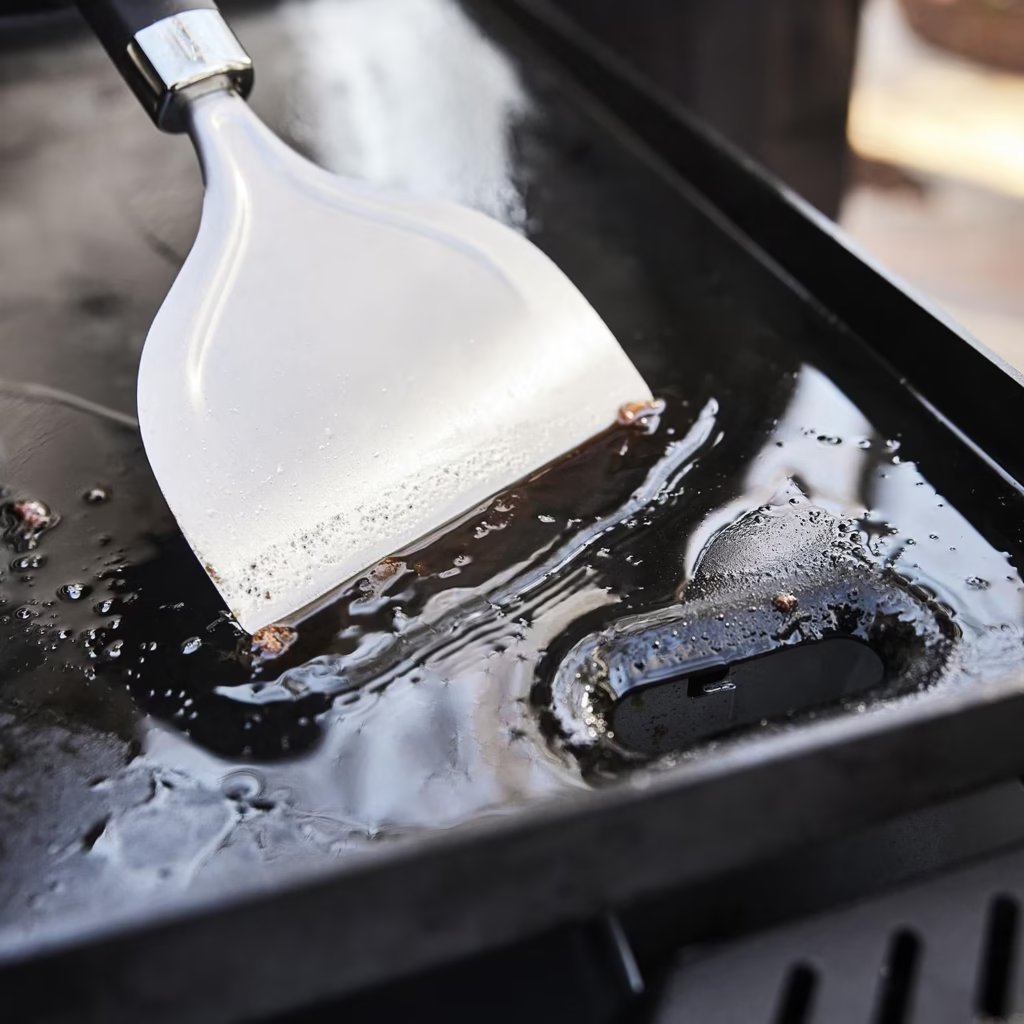
6. Check the Grease-Management System
Grease management is one of the most overlooked parts of learning how to buy a griddle.
Every cook produces grease, oil, food particles, and liquid. A poorly designed drain can clog or force you to push debris toward an awkward corner. A shallow or difficult-to-remove grease cup can spill during cleanup.
Compare the following features:
- Location of the grease opening
- Size of the drain
- Capacity of the collection tray
- Access for removal
- Availability of disposable liners
- Protection from rain and pests
- Ease of scraping food toward the drain
Rear grease systems keep the collection area away from the cook, while front systems can be easier to monitor. Neither design is automatically better. The best choice is one that is accessible and does not interfere with your normal cooking motion.
7. Choose Propane, Natural Gas, or Electric
Propane is the most common fuel for freestanding outdoor griddles. A standard 20-pound propane tank is widely available, portable, and does not require a permanent utility connection.
Natural gas is convenient for a permanent outdoor cooking area because you do not have to refill tanks. However, you need an existing gas connection or professional installation, and the griddle must be approved for natural gas or for use with the correct manufacturer-approved conversion kit.
Electric griddles are useful where open-flame appliances are restricted or when you need a smaller appliance. They require access to a suitable electrical outlet and may not provide the same outdoor portability as propane.
Never assume a propane griddle can be converted to natural gas. Verify compatibility with the manufacturer before purchasing any conversion components. Fuel requirements and conversion options vary by individual model.
8. Inspect the Frame, Lid, Shelves, and Wheels
A great cooktop attached to a weak cart is not a great long-term purchase.
Push lightly on the side shelves and control panel when viewing a griddle in person. Excessive movement, thin panels, loose knobs, rough welds, and lightweight hardware can indicate cost-cutting in areas that may become noticeable after repeated use.
Look for:
- A stable frame
- Strong casters with locking wheels
- Solid burner controls
- Useful side-shelf space
- A hard lid or hood
- Secure propane-tank storage
- Hooks or rails for tools
- Replacement-part availability
- Finished edges without sharp corners
A hard lid protects the cooktop between uses but is not a substitute for a full weather cover. The lid protects the cooking surface, while a cover also shields the control panel, cart, shelves, and lower storage area.
9. Consider Cleanup and Maintenance
Every steel griddle requires routine care. The process should not be difficult, but it should be part of your buying decision.
After cooking, scrape loose debris toward the grease drain while the surface is still warm. Water can help release stubborn residue, but the cooktop should be dried thoroughly afterward. Finish with a very thin layer of oil to protect the surface until the next cook.
Keeping the appliance covered is particularly important if it remains outside through rain, humidity, or winter weather. Steel and cast-iron cooking surfaces can be seasoned again if needed, but preventing moisture exposure is much easier than repairing widespread rust.
Before buying, check whether replacement grease trays, burners, igniters, knobs, lids, and other common components are readily available. Here’s our article ➡ Why is my Griddle Sticky.
10. Calculate the Real Cost of Ownership
The purchase price is only part of the cost.
Depending on the model, you may also need:
- A fitted weather cover
- Two griddle spatulas
- A scraper
- Squeeze bottles
- An infrared thermometer
- A melting dome
- Grease-tray liners
- Cleaning supplies
- A propane tank
- Replacement oil and paper towels
- Griddle Starter Kit with everything above
A less expensive griddle may still be a good value, but compare what is included. A model with a hard lid, sturdy cart, large shelves, better warranty, and useful storage may cost less over time than a basic unit that requires immediate upgrades.
Avoid paying for accessory systems you will never use. Spend first on cooking performance, stable construction, an effective grease system, and reliable manufacturer support.
Common Griddle-Buying Mistakes
The most common mistake is buying entirely on price. An inexpensive griddle can cook good food, but weak frames, uneven heating, limited parts support, and poor grease management can become frustrating.
Other mistakes include:
- Buying a griddle that is too small
- Buying a 36-inch model without measuring the patio
- Focusing only on BTUs
- Ignoring the grease tray
- Assuming every model can use natural gas
- Leaving the cooktop exposed to weather
- Choosing accessories before evaluating build quality
- Failing to check the warranty
Take time to see the appliance in person when possible. Open the lid, turn the knobs, roll the cart, remove the grease tray, and inspect the cooking surface.
My Recommendation: Weber Slate 3-Burner Griddle
My recommendation for most backyard cooks is the Weber Slate 3-Burner Griddle.
I own this griddle, and I believe it offers an excellent balance of durability, cost, cooking performance, and overall workmanship. It is not the cheapest griddle available, but it feels like a more finished and substantial outdoor appliance than many entry-level models.
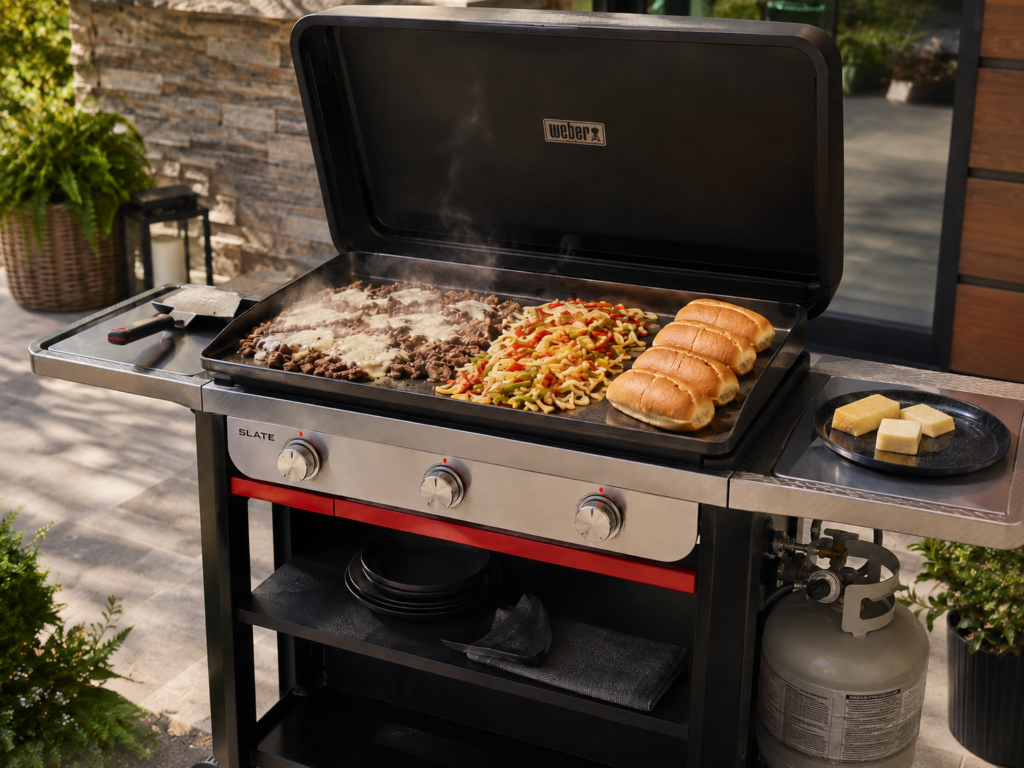
The three independently controlled burners provide the flexibility needed for multi-zone cooking. That makes it possible to cook meat, vegetables, and buns at different temperatures without constantly moving everything around the surface.
The 30-inch model has a 540-square-inch carbon-steel cooking surface, reaches temperatures above 500°F, includes wind guards, and is designed to provide even heat across the cooktop. Weber currently lists the standard model at approximately $699, although prices and retailer configurations can change.
I also place considerable value on Weber’s workmanship, replacement-parts network, and warranty support. Weber currently provides five-year warranty coverage across the griddle cookbox, hard-cover assembly, burner tubes, carbon-steel cooktop, and remaining parts, subject to its warranty terms and exclusions.
No outdoor griddle is maintenance-free, including the Slate. The cooktop still needs to be cleaned, dried, lightly protected with oil, and kept covered. However, its construction, controlled heating, usable cooking area, and quality of finish make it the griddle I would purchase again.
For someone who wants a dependable family-sized griddle without moving all the way up to an oversized four-burner unit, the Weber Slate 3-Burner is my top recommendation.
Frequently Asked Questions
What size griddle is best for a family of four?
A 28- to 30-inch griddle is usually a good size for a family of four. It offers enough room for complete meals without taking up as much patio space as a 36-inch model.
Are three burners enough for an outdoor griddle?
Three independently controlled burners are enough for most families. They allow you to create high-, medium-, and low-temperature zones across the cooking surface.
Is a griddle better than a gas grill?
A griddle is better for foods such as eggs, pancakes, smash burgers, fried rice, chopped vegetables, and cheesesteaks. A traditional grill is better when you want open-flame flavor, grill marks, or indirect cooking. Many backyard cooks enjoy owning both.
Do outdoor griddles rust?
Unprotected steel griddle surfaces can rust when exposed to moisture. Cleaning, drying, lightly oiling, and covering the griddle greatly reduces the risk. Follow the manufacturer’s care instructions for your particular cooktop.
Is a lid necessary on an outdoor griddle?
A hard lid is strongly recommended because it protects the cooktop from debris and moisture between cooks. A full weather cover provides additional protection for the frame, burners, control panel, and shelves.
Is the Weber Slate worth the money?
In my opinion, yes. I own the Weber Slate 3-Burner and recommend it because of its durable construction, thoughtful design, workmanship, controlled heating, and overall value. It costs more than many entry-level griddles, but the difference is reflected in the complete appliance rather than only the cooking surface.
Final Thoughts
Understanding how to buy a griddle comes down to matching the appliance to your cooking habits. Choose the correct size, prioritize independent heat zones, inspect the cooking surface and frame, and make sure the grease system is easy to use.
Do not judge a griddle by burner output or price alone. Even heating, controlled temperatures, replacement parts, warranty coverage, and long-term durability matter more after the excitement of the first few cooks wears off.
For most families seeking a premium but reasonably sized outdoor griddle, my recommendation is the Weber Slate 3-Burner. It offers the capacity, workmanship, and durability needed for regular backyard cooking without becoming unnecessarily large or complicated.
Here’s my Smash Burger Article and Temp Guide to get you started!
🔥 Shop BSL Favorites on Amazon!
📄 Get Free BBQ Recipes, Guides & Charts
👉Check out the list of BBQ Gear I recommend and use
🔥 Follow Backyard Smoke Lab for more BBQ tips, recipes, and reviews
📺 YouTube: https://www.youtube.com/@backyardsmokelab
📸 Instagram: https://www.instagram.com/backyardsmokelab
🎵 TikTok: https://www.tiktok.com/@backyardsmoklab
🌐 Website: https://backyardsmokelab.com