
Correct temperature probe placement can mean the difference between juicy, perfectly cooked meat and a meal that is dry, tough, or unsafe to eat. Even the most accurate digital thermometer will give you a misleading reading when its probe touches bone, sits in a pocket of fat, or stops too close to the surface.
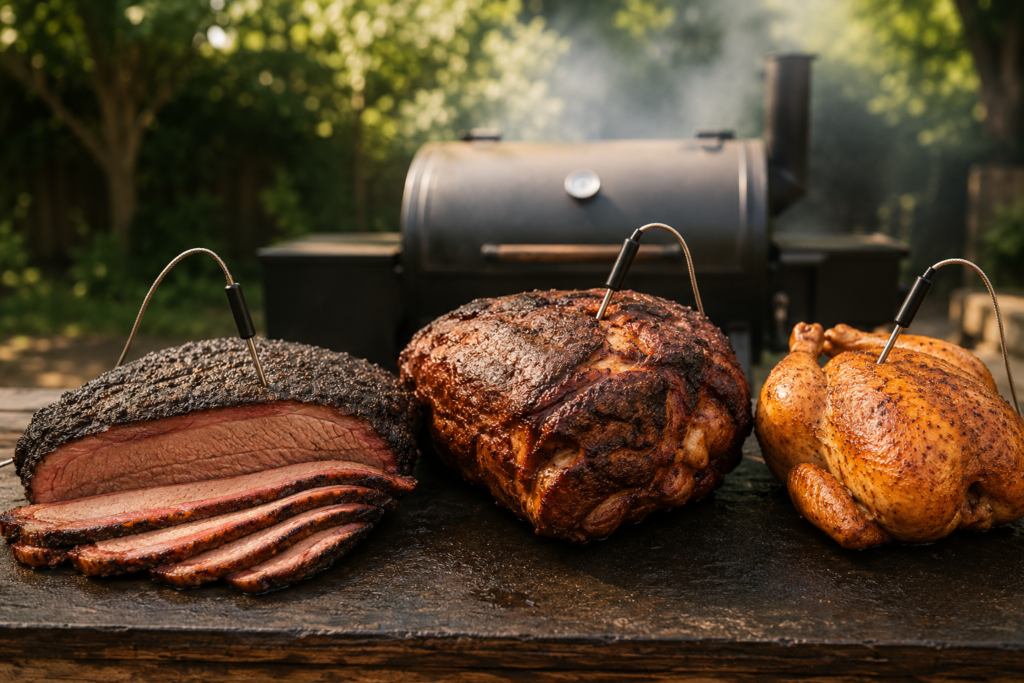
The basic rule is simple: insert the thermometer into the thickest edible portion of the meat, aiming for the center of the muscle while avoiding bones, large seams of fat, cartilage, and gristle. For large or irregularly shaped cuts, check several locations before deciding the meat is finished.
However, finding that ideal location is not always obvious. A brisket contains two major muscles. A whole chicken has breast, thigh, and wing sections that cook differently. Ribs provide very little space between the surface and the bones.
This guide explains exactly where to position your temperature probe in nearly every common cut of poultry, beef, and pork.
Quick Temperature Probe Placement Chart
| Meat or cut | Best probe location | What to avoid |
|---|---|---|
| Whole chicken | Deepest part of breast and innermost thigh | Breastbone, thigh bone, cavity |
| Whole turkey | Thickest breast plus innermost thigh and wing | Bone and empty cavity |
| Chicken breast | Center of thickest section | Surface, rib bone |
| Chicken thigh | Thickest meat beside the thigh bone | Direct bone contact |
| Drumstick | Thickest muscular section near the upper end | Leg bone |
| Chicken wings | Thickest meat section | Wing bones |
| Brisket | Center of the thickest part of the flat | Fat seam between flat and point |
| Steak | Thermal center, preferably from the side | Bone, fat cap, grill surface |
| Beef roast | Center of the thickest portion | Bone and large fat seams |
| Burger | Sideways into the center of the patty | Grill grate and surface |
| Pork butt | Deep center of the largest muscle | Shoulder blade bone and fat pockets |
| Pork loin | Center of the thickest section | Fat cap and pan |
| Pork tenderloin | Sideways into the thickest portion | Thin tapered end |
| Pork chop | Sideways into the center | Bone and fat edge |
| Pork ribs | Meat between two bones near the center of the rack | Direct bone contact |
| Meatloaf | Center of the loaf | Pan and outer crust |
| Sausage | Insert lengthwise into the center | Cooking surface |
| Fish fillet | Thickest central section | Pan, grill grate, thin tail |
Why Temperature Probe Placement Matters
The temperature inside a piece of meat is not uniform. Heat travels from the cooking surface toward the center, making the thermal center—the area farthest from the exterior—the last section to reach the target temperature.
A probe positioned too close to the exterior may tell you the meat is ready while the center is still undercooked. A probe touching hot bone can also produce an inaccurate reading. Fat pockets may heat differently from the surrounding muscle and are not reliable places to measure doneness.
For the most accurate result, push an instant-read thermometer slightly past the expected center and slowly pull it back. Watch the display as the probe moves. The lowest stable temperature usually represents the coolest section and is the reading that matters most.
Leave-in probes should remain positioned in the center of the thickest muscle throughout the cook. Before serving, verify the temperature in several additional locations with a fast instant-read thermometer.
Need a Good Temperature Probe? Check out our Buyers Guide or probes I use.
Temperature Probe Placement in Poultry
All poultry—including whole birds, breasts, thighs, wings, and ground poultry—should reach a safe minimum internal temperature of 165°F. Large birds should be checked in more than one location because the breast and dark meat can cook at different rates.
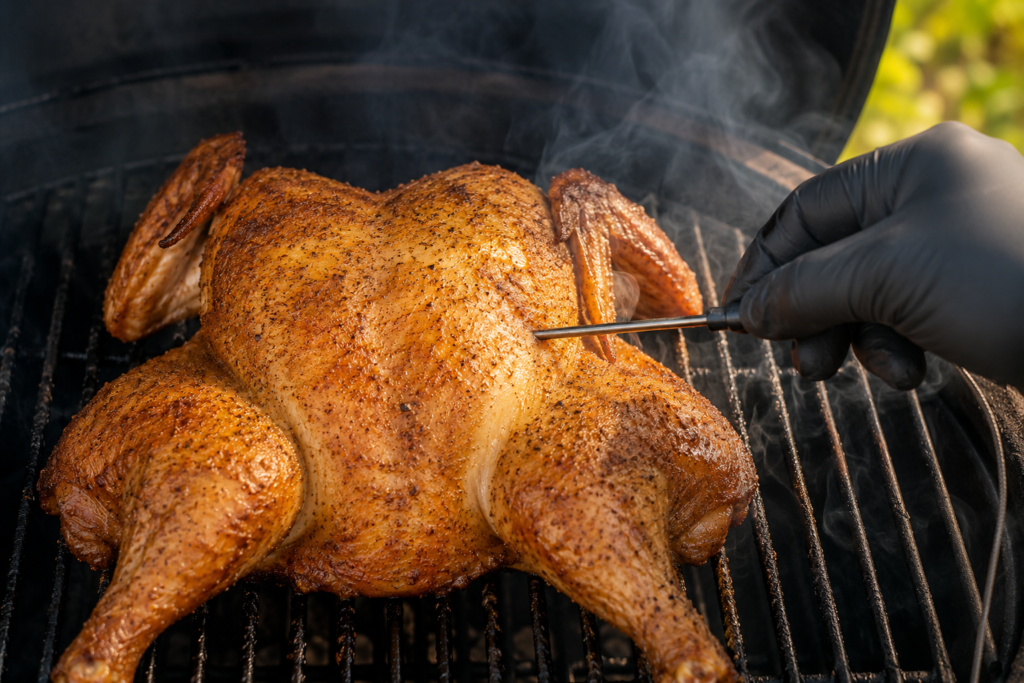
Whole Chicken
For a whole chicken, place a leave-in probe into the deepest portion of the breast. Insert it from the side or front so the tip reaches the center of the breast muscle without touching the breastbone or entering the cavity.
Before removing the chicken, use an instant-read thermometer to check:
- The thickest part of each breast
- The innermost section of the thigh
- The thickest portion near the wing joint
The USDA recommends checking whole poultry in the innermost thigh and wing and the thickest part of the breast.
Do not insert the breast probe straight down without considering its depth. It can pass through the breast meat and enter the empty cavity, producing a reading that does not represent the chicken.
Spatchcock Chicken
A spatchcock chicken lies flatter than a traditional whole bird and normally cooks more evenly. Place the leave-in probe horizontally into the thickest portion of one breast.
Verify both breasts and both thighs before serving. The side closest to the firebox, burner, or hottest part of the grill may cook faster.
Chicken Breast
Insert the probe into the thickest section of the breast. For smaller boneless breasts, approach from the side so more of the probe remains inside the meat.
Avoid inserting the tip close to the tapered end. That thin section cooks much faster and can reach 165°F while the thick center remains below the target.
When cooking several breasts, check each one individually. Differences in thickness can cause them to finish at different times.
Chicken Thighs
Place the thermometer in the thickest portion of the thigh beside the bone, not against it. Approach from the side and feel for the center of the meat.
Chicken thighs are safe at 165°F, but their connective tissue becomes more tender when cooked beyond the minimum temperature. Many cooks prefer thighs in approximately the 175°F to 185°F range for a softer texture.
Probe several thighs because their sizes can vary considerably.
Chicken Drumsticks 🍗
Insert the thermometer into the thickest muscular section near the upper end of the drumstick. Push the probe toward the center while avoiding the leg bone.
Drumsticks contain more connective tissue than breasts and generally benefit from being cooked beyond 165°F for improved tenderness.
Chicken Wings
Wings can be difficult to measure because the bones occupy most of the available space. Insert a thin instant-read probe into the thickest area without touching either bone.
Check several of the largest wings. The USDA specifies that wings should reach 165°F and recommends measuring the thickest portion while avoiding bone.
Whole Turkey and Turkey Breast
For a whole turkey, position the primary leave-in probe in the thickest section of the breast. Before removing the turkey, check the thickest part of both breasts, the innermost thigh, and the innermost wing.
Do not rely only on the pop-up indicator included with some turkeys.
For a separate turkey breast, place the probe in the center of the thickest breast meat. Keep the probe away from the breastbone and rib cage. USDA guidance calls for whole turkeys to reach 165°F in the breast, innermost thigh, and innermost wing.
Temperature Probe Placement in Beef
Brisket
For brisket, insert the primary leave-in probe into the thickest central portion of the flat. The flat is the long, relatively uniform muscle that determines whether the brisket slices are properly tender.
Avoid positioning the tip in:
- The fat seam between the point and flat
- A thick exterior fat cap
- The extremely thin end of the flat
- A pocket of soft rendered fat
When using a thermometer with multiple channels, place one probe in the flat and a second in the point. The two muscles can cook at different rates, and monitoring both provides a more complete picture.
Brisket commonly becomes tender around 195°F to 205°F, but temperature is only a guide. Begin checking the flat with an instant-read thermometer or skewer. It is finished when the probe slides into several locations with very little resistance.
Steaks 🥩
For steaks at least one inch thick, insert an instant-read thermometer from the side and aim for the thermal center. Side insertion makes it easier to keep the sensing area surrounded by meat instead of passing through the steak.
For an especially thick steak, insert slightly past the center and slowly withdraw the probe. Use the lowest stable temperature you find.
With bone-in steaks, keep the probe away from the bone. Also avoid large exterior fat pockets.
USDA guidance lists 145°F with a three-minute rest as the safe minimum for whole beef steaks, roasts, and chops.
Beef Roasts and Prime Rib
Insert a leave-in probe into the center of the thickest section of the roast. On a boneless roast, approach from one end so the probe follows the roast’s length and reaches its thermal center.
For bone-in prime rib, insert from the side opposite the bones and keep the tip centered between the exterior and the rib bones.
Check more than one location before removing a large roast. Its shape, fat distribution, and distance from the heat source can create temperature differences.
Burgers
Insert an instant-read thermometer horizontally through the side of the burger until the sensing area reaches the center.
Inserting vertically from the top can place the tip too close to the hot grill grate, especially with thin patties. Ground beef should reach a minimum internal temperature of 160°F.
Meatloaf
Place the thermometer in the center of the loaf, away from the pan and outer crust. Check both the middle and the thickest end.
Beef, pork, lamb, and veal meatloaf should reach at least 160°F. Meatloaf containing ground poultry should reach 165°F.
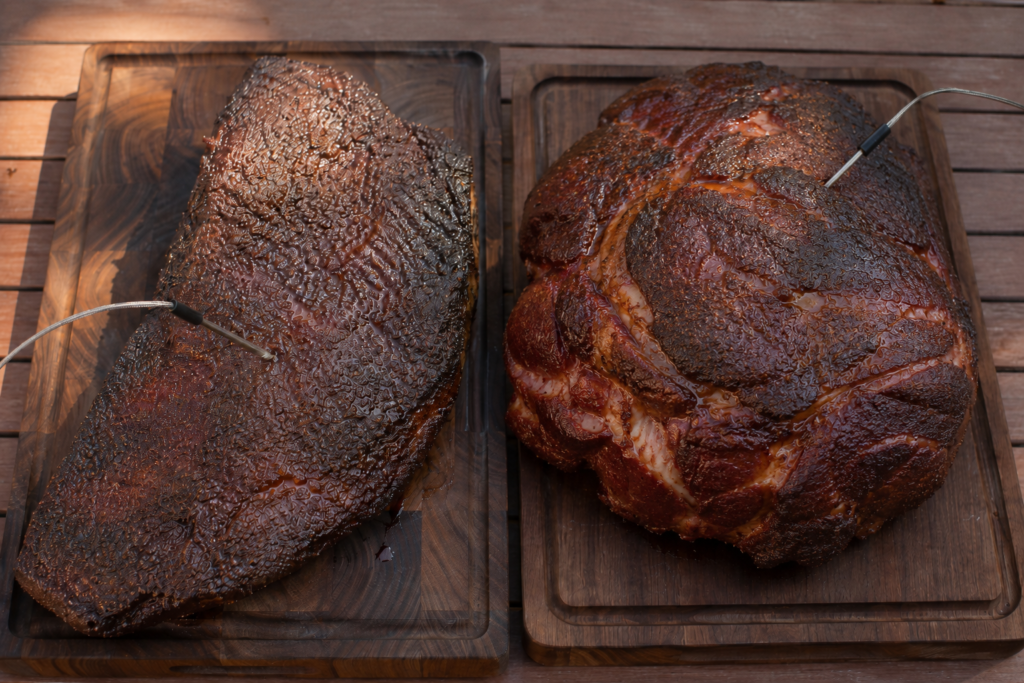
Temperature Probe Placement in Pork
Pork Butt or Pork Shoulder
Insert the leave-in probe into the deepest central portion of the largest muscle. On a bone-in Boston butt, approach from the side opposite the exposed end of the shoulder blade bone.
Before inserting the probe, estimate where the bone sits inside the roast. The probe should be surrounded by solid meat rather than touching the bone or sitting in one of the shoulder’s internal fat seams.
Pork shoulder is technically safe before it becomes tender enough to pull. For traditional pulled pork, it commonly finishes around 195°F to 205°F. Final doneness should be confirmed by probing several areas for tenderness rather than relying on one exact number.
Pork Loin Roast
Place the probe in the center of the thickest section of the loin. Insert from the end or side so the tip remains centered between the top, bottom, and sides.
Avoid the outer fat cap. Pork loin is lean, so inaccurate placement and overcooking can quickly dry it out.
Whole pork roasts should reach at least 145°F followed by a three-minute rest.
Pork Tenderloin
Pork tenderloin narrows sharply toward one end. Measure the thickest central section rather than the tapered tail.
Insert the thermometer horizontally from the side. Because tenderloins are relatively narrow, an instant-read thermometer is often easier to position accurately than a thick leave-in probe.
Check both tenderloins separately when the package contains two pieces.
Pork Chops
Insert the thermometer horizontally through the side of the chop and aim for the center of the thickest section.
With bone-in pork chops, keep the probe away from both the bone and the exterior fat strip. Whole pork chops should reach at least 145°F and rest for three minutes.
Pork Ribs
For baby back or spare ribs, insert a thin probe into the meat between two bones near the center of the rack. The tip should sit halfway between the bones and centered within the thickness of the meat.
Ribs are difficult to measure accurately because the meat is thin and surrounded by bones. Even a small placement error can change the reading. Use temperature as one clue, then confirm doneness with tenderness, surface cracking, bone exposure, or a bend test.
For individually cut party ribs, insert the probe into the thickest meat section from the end or side while avoiding the bone.
Sausage and Bratwurst
Insert a thin instant-read thermometer through the end of the sausage and push it lengthwise toward the center.
This approach keeps more of the probe surrounded by food and reduces the chance of poking through the casing. Sausages made from ground beef or pork should reach 160°F. Poultry sausage should reach 165°F.
Fish and Seafood Probe Placement
For thick fish fillets, insert the thermometer into the thickest central portion. Side insertion works well for salmon, tuna steaks, swordfish, and other thick cuts.
For thin fillets, lift the fish carefully and insert the probe horizontally into the thickest area. Avoid allowing the probe tip to touch the pan or grill grate.
The USDA safe minimum temperature for fish is 145°F.
Where to Place an Ambient Smoker Probe
An ambient probe measures the cooking temperature surrounding the meat. It should not touch the grate, smoker wall, water pan, or food.
Clip it at grate level near the meat, generally about one inch away from the food. Keep it several inches from the outer edge of the cooking grate, where temperatures may not represent the area surrounding the meat.
On a large offset smoker, place the ambient probe beside the cut you are monitoring. When cooking across multiple shelves or zones, use more than one ambient probe to identify temperature differences.
Thermometer manufacturer guidance recommends keeping an ambient probe approximately one inch from the meat and at least two inches from the outside edge of the grate.
Common Temperature Probe Placement Mistakes
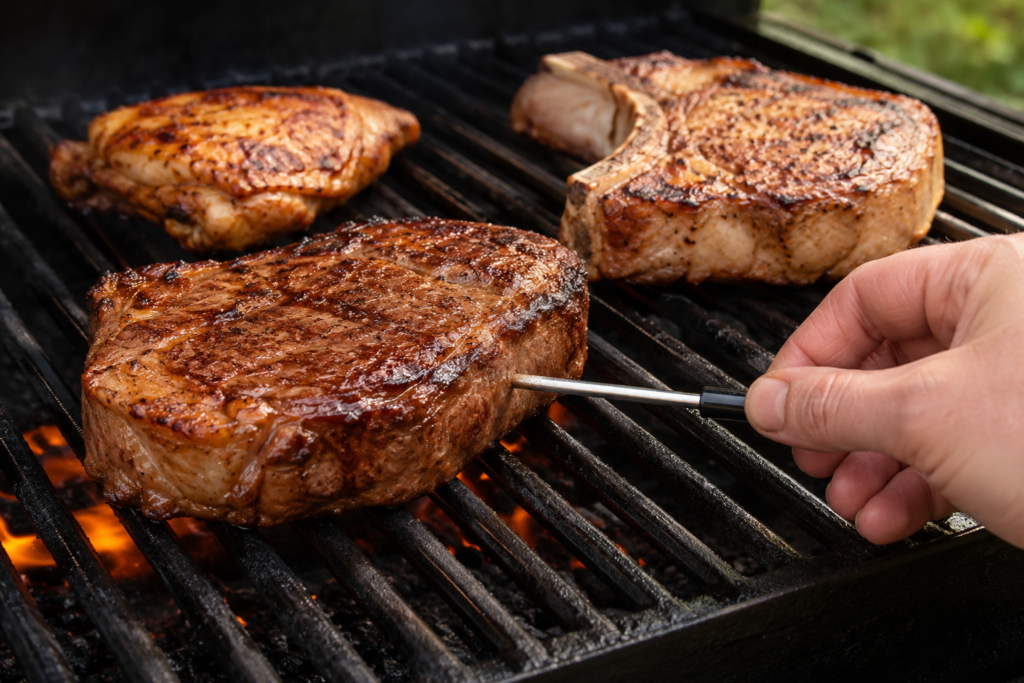
Touching the Bone
Bones can conduct heat differently from the surrounding muscle. Reposition the probe whenever you feel it make hard contact.
Measuring a Fat Pocket
A probe buried in rendered fat does not tell you the temperature of the muscle you plan to eat. Remove it and aim for solid meat.
Stopping Too Close to the Surface
The exterior cooks before the center. Make sure the probe’s sensing area reaches the thermal center rather than stopping in the hotter outer layer.
Checking Only One Location
Large roasts and whole birds can contain several different temperatures. Verify the result in multiple areas before removing the food.
Leaving the Probe in the Wrong Place After Wrapping
A probe can shift when brisket, pork butt, or ribs are wrapped. After returning the meat to the smoker, confirm that the probe is still centered in the muscle and has not entered a fat seam.
Using the Wrong Thermometer for Thin Meat
Large leave-in probes can be difficult to position in wings, ribs, thin chops, and small chicken pieces. Use a thin-tip instant-read thermometer and approach from the side.
Safe Minimum Internal Temperature Guide
| Food | USDA minimum temperature |
| Whole beef, pork, veal, and lamb steaks, chops, and roasts | 145°F plus a three-minute rest |
| Ground beef, pork, veal, and lamb | 160°F |
| Whole poultry and poultry pieces | 165°F |
| Ground poultry | 165°F |
| Fish | 145°F |
| Leftovers and casseroles | 165°F |
These are food-safety minimums, not necessarily the ideal tenderness temperatures for every barbecue cut. Brisket, pork shoulder, ribs, chicken thighs, and other connective-tissue-heavy cuts may need additional cooking to develop the desired texture.
Frequently Asked Questions
How far should a meat thermometer be inserted?
Insert the probe far enough for its sensing area to reach the thermal center of the meat. Sensor locations vary by thermometer, so check the manufacturer’s instructions. On many fast digital thermometers, the sensor is located near the tip.
Can a meat probe touch the bone?
No. Avoid direct contact with bone because it can produce a reading that does not accurately represent the surrounding meat.
Where should I place a probe in a whole chicken?
Place the main leave-in probe in the deepest part of the breast without touching the breastbone or entering the cavity. Before serving, check the innermost thigh, wing, and thickest part of both breasts.
Where should I place a probe in a pork butt?
Position it deep in the center of the largest solid muscle, away from the shoulder blade bone and major fat seams. Check several locations for tenderness near the end of the cook.
Where should I place a probe in brisket?
Place the primary probe in the thickest central part of the flat. With a multi-channel thermometer, place a second probe in the point.
Should the ambient probe touch the grill grate?
No. Secure the ambient probe in its grate clip so the sensor is suspended above the cooking grate. Keep it near the meat but not close enough to be cooled by the meat’s surface.
Why does my thermometer show different temperatures in the same cut?
Different sections can cook at different rates because of thickness, fat, bones, airflow, and proximity to the heat source. Use the lowest temperature found in the thickest edible area when determining whether the meat is ready.
Final Thoughts on Temperature Probe Placement
Accurate temperature probe placement starts with finding the thickest edible portion of the meat and locating its thermal center. Keep the sensor away from bone, fat pockets, gristle, cooking surfaces, and empty poultry cavities.
Use a leave-in probe to monitor large cuts during the cook, but verify the result with an instant-read thermometer in several locations. The combination of correct meat probe placement, safe internal temperatures, and a final tenderness check will produce more consistent results whether you are smoking brisket, pulling pork, grilling steaks, or cooking a whole chicken.
🔥 Shop BSL Favorites on Amazon!
📄 Get Free BBQ Recipes, Guides & Charts
👉Check out the list of BBQ Gear I recommend and use
🔥 Follow Backyard Smoke Lab for more BBQ tips, recipes, and reviews
📺 YouTube: https://www.youtube.com/@backyardsmokelab
📸 Instagram: https://www.instagram.com/backyardsmokelab
🎵 TikTok: https://www.tiktok.com/@backyardsmoklab
🌐 Website: https://backyardsmokelab.com