
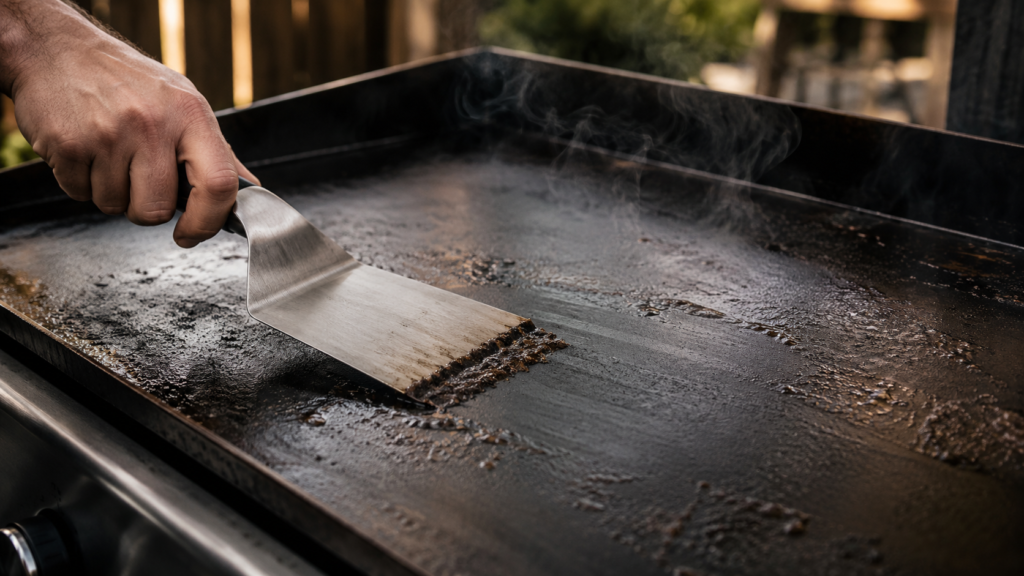
If you’ve walked out to cook and wondered, why is my griddle sticky?, the most likely cause is too much oil during seasoning or oil that never fully bonded to the cooking surface. Sticky griddle surfaces can also come from sugary sauces, grease buildup, cooking spray residue, improper cleaning, or even a protective coating left on a brand-new griddle.
The good news: a sticky griddle usually isn’t ruined and can normally be restored without replacing the cooktop.
In most cases, the solution is simple: heat the surface, scrape away the gummy residue, wipe it clean, evaluate the seasoning, and apply a very thin new coat of oil if necessary.
Why Is My Griddle Sticky?
Before stripping seasoning or attacking the cooktop with a cleaning stone, figure out what you’re actually dealing with.
Here’s a quick way to diagnose a sticky griddle:
| What You’re Seeing | Likely Cause |
|---|---|
| Sticky everywhere after seasoning | Too much oil |
| Sticky or gummy patches | Uneven or puddled oil |
| Sticky after BBQ sauce, honey or teriyaki | Sugar residue |
| Sticky after several cooks | Grease and carbon buildup |
| Brand-new griddle feels oily or tacky | Protective factory coating |
| Food sticks but surface doesn’t feel tacky | Preheating, seasoning or cooking-temperature issue |
The distinction matters because food sticking to a griddle isn’t necessarily the same thing as having a sticky griddle surface.
If you can run a clean paper towel across a cool griddle and it feels gummy, tacky or drags across certain areas, you’re probably dealing with residue or improperly bonded oil.
If the surface feels smooth but eggs, pancakes or other foods stick while cooking, look first at your heat, preheating time and cooking technique.
Cause #1: Too Much Oil During Seasoning
Using too much oil is one of the most common answers to why is my griddle sticky after seasoning?
It’s also an easy mistake to make.
If a little oil protects the griddle, it seems logical that more oil would provide even more protection. Griddle seasoning doesn’t work that way.
You want an extremely thin film of oil across the steel. When heated properly, that thin film changes into a hard seasoning layer bonded to the cooking surface.
A thick coat can remain partially liquid or gummy instead.
Puddles are especially problematic. Oil naturally collects in low areas, corners and around the edges of a griddle. Those thicker spots may never season as evenly as the almost invisible layer you’re trying to create.
If you own a Blackstone Here’s their seasoning article.
How much oil should you use?
Less than you probably think.
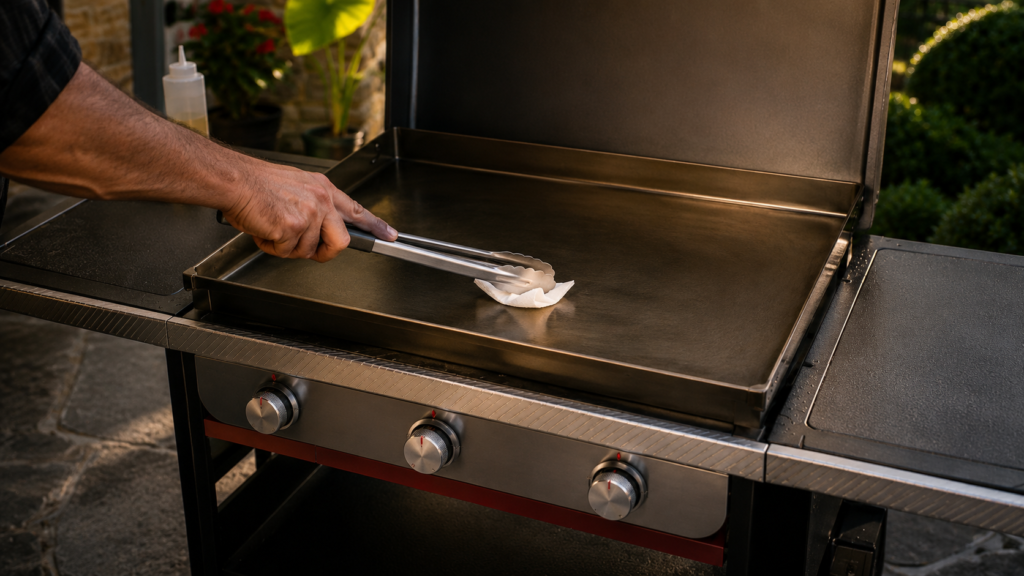
Add a small amount of seasoning oil and spread it across the entire cooking surface with a folded paper towel held in long tongs. Continue wiping until it almost looks like you’ve removed all the oil.
That’s usually much closer to the layer you want.
A squeeze bottle makes controlling the amount easier than pouring directly from a large oil container.
When seasoning a griddle, thin coats beat thick coats every time.
Cause #2: The Oil Didn’t Fully Season
Even if you used the right amount of oil, you can still end up asking why is my griddle sticky? if the oil never finished bonding to the steel.
This is where polymerization comes into play.
You don’t need a chemistry lesson to understand it. Think of seasoning as converting a microscopically thin film of oil into a harder protective layer by applying enough heat.
During seasoning, the griddle should get hot enough for the thin layer of oil to begin smoking. Give that layer enough time to finish the process before adding another coat.
Adding the next layer too quickly can stack fresh oil on top of oil that hasn’t finished seasoning.
The result can be a soft or tacky surface instead of the smooth, dark cooking surface you were expecting.
Patience matters here.
Thin layer → heat → smoke → finish bonding → repeat.
Don’t keep pouring more oil onto a sticky surface hoping it will eventually improve. That usually makes the problem worse.
Cause #3: Sugary Sauces Can Leave a Sticky Griddle
Not every sticky griddle is a seasoning problem.
BBQ sauce, honey, brown sugar, teriyaki sauce and many marinades contain enough sugar to create a surprisingly stubborn film on a hot cooktop.
Anyone who’s cooked sauced chicken, teriyaki steak or sticky wings on a flat top has probably seen it happen.
The sugars hit the hot steel, caramelize and eventually burn. If that residue isn’t removed while the griddle is still warm, it can cool into a hard or tacky layer that looks like damaged seasoning.
Before stripping the griddle, ask yourself what you cooked last.
If the problem appeared immediately after using a sugary sauce, start with cleaning rather than reseasoning.
While the griddle is warm—not screaming hot—use a quality griddle scraper to work underneath the residue. A small amount of water can help loosen stubborn food residue by creating steam.
Scrape the loosened debris toward the grease trap, wipe the surface clean and then evaluate it again.
Cause #4: Grease and Carbon Buildup
A griddle gets better with use, but that doesn’t mean every layer left behind should become part of the seasoning.
Tiny pieces of food, grease and burned residue can accumulate over time.
Eventually, you aren’t cooking directly on a clean seasoned surface anymore. You’re cooking on top of old residue.
That can cause rough areas, black flakes, gummy spots and uneven food release.
The easiest time to prevent this is immediately after cooking.
After removing the food, leave the griddle warm and scrape away debris. Wipe the surface clean before everything has a chance to cool and harden.
For heavier buildup that won’t come loose with routine scraping, a griddle cleaning stone can help restore the surface.
I wouldn’t immediately grind down an otherwise healthy cooktop every time you see a small sticky patch, however. Start with the least aggressive method and move to a cleaning stone only when the buildup actually requires it. Check your griddle care instructions before using this method.
Cause #5: Cooking Spray Residue
Cooking sprays deserve a little clarification.
The problem isn’t that every product in a spray can is automatically bad for a griddle. There are dedicated griddle sprays designed specifically for flat-top cooking and maintenance.
However, some general-purpose aerosol nonstick sprays contain ingredients in addition to cooking oil. Repeated use can contribute to a sticky film, particularly when residue is allowed to accumulate.
If you’re constantly cleaning unexplained tacky areas, simplify things.
Try using a regular high-smoke-point cooking oil applied from a squeeze bottle instead.
That gives you better control over how much oil hits the cooking surface and eliminates another variable while you’re diagnosing the problem.
Cause #6: Improper Preheating
Sometimes the griddle isn’t actually sticky at all—the food is sticking to it.
That’s an important difference.
Putting food onto a steel griddle before the surface has properly preheated can produce disappointing results even if your seasoning is fine.
Eggs are one of the best examples. Put an egg on a poorly heated or poorly lubricated section of the cooktop and suddenly it looks like your seasoning has failed.
Give the griddle time to preheat before cooking.
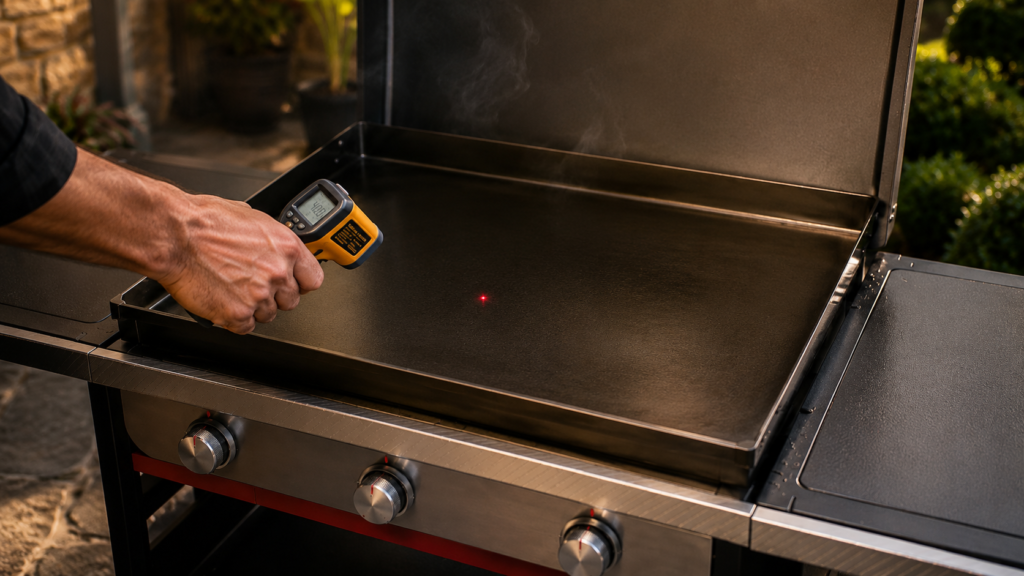
An infrared thermometer is one of my favorite types of tools for flat-top cooking because it takes the guesswork out of surface temperature. Instead of assuming the left side, center and right side are the same temperature, you can actually check them.
That’s especially helpful when you’re learning how your particular griddle heats.
If the surface feels smooth when it’s cool but food sticks when you cook, investigate temperature and technique before rebuilding your seasoning.
Cause #7: A Brand-New Griddle May Have a Protective Coating
If you’re asking why is my griddle sticky before you’ve even cooked on it, don’t panic.
Some steel griddles leave the factory with a protective oil or coating intended to help prevent corrosion during manufacturing, shipping and storage.
That isn’t the seasoning you want to cook on.
Follow the manufacturer’s initial-cleaning instructions before seasoning a new griddle. This is one of the few times a thorough wash with soap and water may be specifically recommended.
Rinse the cooktop thoroughly and dry it completely.
Then heat the griddle and begin the manufacturer’s seasoning procedure using extremely thin coats of seasoning oil.
Don’t simply turn on a brand-new griddle and start building seasoning over an unknown layer of shipping residue.
How to Fix a Sticky Griddle
If you’ve confirmed that the actual cooking surface feels gummy or tacky, here’s the process I recommend:
Step 1: Heat the griddle
Turn on the burners and allow the cooking surface to warm.
Heat softens greasy residue and makes it much easier to remove than trying to attack a cold griddle.
You don’t need to immediately take the griddle to maximum temperature. The goal at this point is to make the residue easier to work with.
Step 2: Scrape the surface
Use a flat griddle scraper at a shallow angle and work across the sticky areas.
Push loosened oil, food particles and residue toward the grease trap.
Pay particular attention to areas where oil may have pooled.
Don’t gouge the cooktop by attacking it with the corner of the scraper. Keep the blade reasonably flat against the surface.
Step 3: Wipe it clean
Once you’ve removed the loose material, carefully wipe the warm surface with paper towels held in long tongs.
Look at the paper towel.
If you’re still picking up thick brown grease or gummy residue, continue cleaning.
You want to get back to a reasonably clean, smooth surface before deciding whether additional restoration is necessary.
Step 4: Deal with stubborn buildup
If scraping and wiping aren’t enough, a griddle cleaning stone can help remove more stubborn layers.
This is especially useful when thick seasoning, burned food residue and old oil have combined into a rough surface.
Work gradually.
You aren’t trying to remove steel. You’re trying to eliminate the defective buildup sitting on top of it.
Afterward, remove all loosened debris and wipe the cooktop thoroughly.
Step 5: Evaluate the existing seasoning
You don’t automatically need to strip the entire griddle down to bare metal.
If most of the cooktop is smooth, dark and firmly seasoned, leave the good seasoning alone.
Concentrate on repairing the problem areas.
If the entire surface is thick, gummy, peeling or badly uneven, a more complete restoration may make sense.
Step 6: Lightly reseason the griddle
Once the surface is clean, apply a small amount of high-smoke-point seasoning oil or griddle conditioner.
Spread it over the cooktop.
Then wipe it again.
And again.
The surface should look almost dry.
Heat the griddle until that thin layer finishes smoking and bonding before considering another coat.
Remember the most important rule in this entire article:
If you’re debating whether you’ve used enough oil, you probably already have.
Step 7: Test the surface
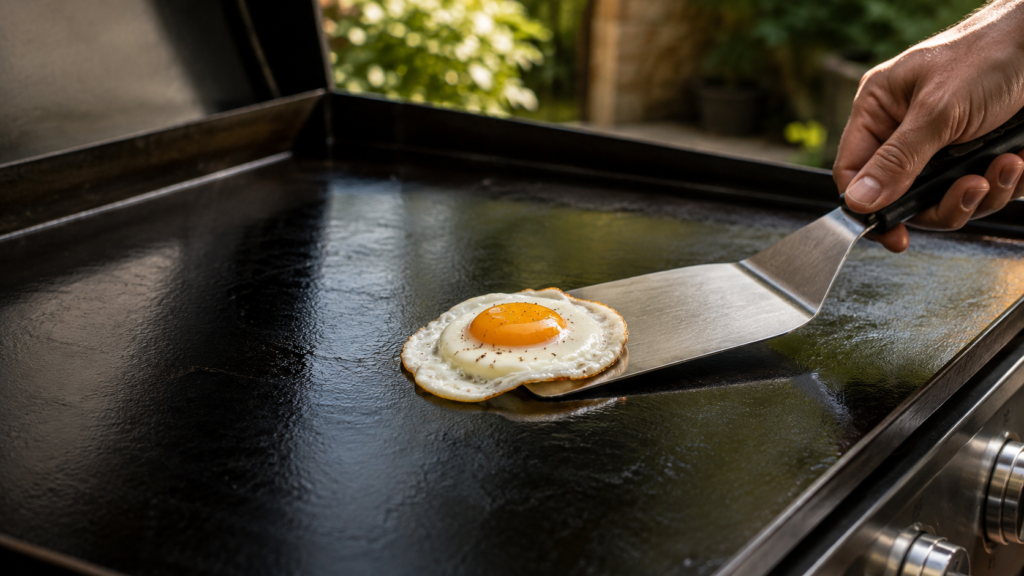
After restoring the griddle, cook something that makes food release easy to evaluate.
An egg works perfectly.
Preheat the griddle, add the appropriate amount of cooking oil or butter for the food you’re preparing, and watch how it releases.
A properly maintained griddle should feel smooth rather than gummy and become increasingly stick-resistant as the seasoning develops.
Check out our ➡ Smash Burger Guide!
How to Prevent Your Griddle From Getting Sticky Again
Once you’ve fixed a sticky griddle, keeping it that way is much easier than doing another restoration.
Clean the griddle while it’s still warm after cooking. Scrape away food debris and sauce before it has time to harden.
Use only the amount of oil you actually need.
For seasoning and storage protection, think thin film, not visible puddles.
When you’re applying oil with a paper towel, wipe aggressively enough that the cooktop nearly appears dry.
Also pay attention after cooking sugary foods. BBQ sauce and teriyaki residue should come off the griddle, not become part of your seasoning.
And protect the cooktop from moisture when it isn’t being used. A properly fitting griddle cover can help protect the entire cooker from weather, while a hard lid or hood provides additional protection for the cooktop depending on your griddle design. Above cover fits a 36″ but has models that fit 28″-72″.
Good griddle maintenance doesn’t require obsessing over a perfectly black cooking surface.
What matters is having a surface that’s clean, smooth, protected from rust and ready to cook.
Check out our article on Blackstone Griddle Covers
Do You Need to Completely Reseason a Sticky Griddle?
Usually, no.
A small sticky patch doesn’t mean you need to strip the entire cooktop.
Heat it, remove the residue, clean the area and determine what’s underneath.
If the surrounding seasoning is smooth and firmly bonded to the steel, preserve it.
Complete reseasoning is more appropriate when the seasoning is failing across a large portion of the cooktop—especially when you have widespread gummy buildup, significant flaking or exposed areas that need to be rebuilt.
Don’t turn a minor maintenance problem into a major restoration project unless the condition of the griddle actually requires it.
Frequently Asked Questions
Why is my griddle sticky after seasoning?
A griddle that’s sticky after seasoning usually has too much oil on the surface or the oil didn’t get enough heat and time to fully bond. Remove the gummy excess and re-season using extremely thin coats.
Can I cook on a sticky griddle?
A slightly tacky spot probably isn’t going to destroy the griddle, but I would clean it before cooking. Sticky residue can transfer to food and continued heating may turn excess oil into thicker buildup.
Fixing the problem now is easier than dealing with several more layers later.
Will a sticky griddle eventually fix itself?
Sometimes continued heating can improve a very light layer of partially seasoned oil, but don’t depend on cooking over thick gummy buildup to fix it.
If the surface is obviously sticky, remove the excess first.
Why does my griddle get sticky after I put oil on it for storage?
You’re probably leaving too much unseasoned oil behind. Oil placed on a griddle for corrosion protection should be an extremely thin film.
If you return later and find gummy patches, clean off the excess and use considerably less oil next time.
Does a sticky griddle mean the seasoning is ruined?
No.
In most cases, a sticky griddle is a maintenance problem, not a ruined cooktop.
Start with the simple approach:
Heat → scrape → wipe → evaluate → lightly reseason.
Save aggressive stripping for the situations that truly need it.
Final Thoughts
If you’re wondering why is my griddle sticky, start with the oil.
Too much seasoning oil—or oil that wasn’t allowed to fully bond—is one of the first things to check. From there, look for sugary sauce residue, grease buildup, cooking spray residue, poor preheating or a protective coating on a new cooktop. Remember cooking food is different than seasoning the Griddle.
Most importantly, don’t respond to a sticky surface by adding even more oil.
Clean the griddle first. Get back to a smooth surface. Then rebuild any seasoning that actually needs attention with very thin coats.
Your griddle probably isn’t ruined….. but if not happy with your Griddle…Here’s out article on How to Buy a Griddle.
It probably just needs a little cleanup and a lot less oil.
🔥 Shop BSL Favorites on Amazon!
📄 Get Free BBQ Recipes, Guides & Charts
👉Check out the list of BBQ Gear I recommend and use
🔥 Follow Backyard Smoke Lab for more BBQ tips, recipes, and reviews
📺 YouTube: https://www.youtube.com/@backyardsmokelab
📸 Instagram: https://www.instagram.com/backyardsmokelab
🎵 TikTok: https://www.tiktok.com/@backyardsmoklab
🌐 Website: https://backyardsmokelab.com