
You planned the perfect football tailgate. The charcoal grill is going, burgers and brats are coming off hot, the canopy is up, and everyone has a plate in their hand.
Then somebody looks at the clock.
Kickoff is getting close.
Chairs start folding. The cooler goes back into the truck. The canopy comes down. But there’s one problem sitting in the middle of the parking lot:
Your charcoal grill is still full of blazing-hot coals.
You planned the perfect football tailgate. But figuring out how to put out charcoal at a tailgate becomes a very real problem when kickoff is approaching and your grill is still full of hot coals.
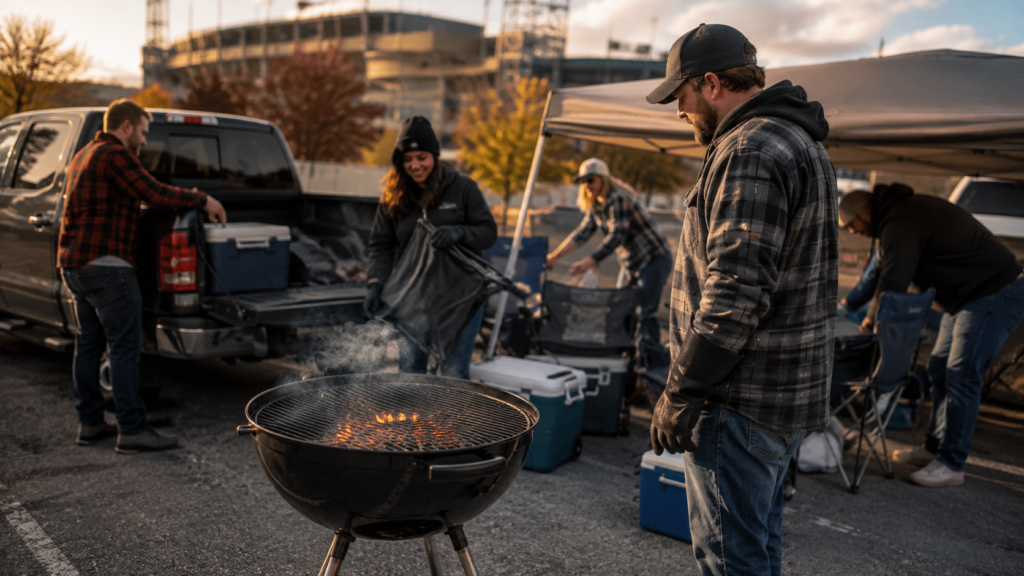
So how do you put out charcoal at a tailgate quickly enough to pack up and head into the game?
The safest solution isn’t necessarily trying to force the entire grill to cool instantly. It’s to stop adding fuel early, safely extinguish or contain the remaining charcoal, and give the grill body enough time to cool before loading it into your vehicle.
A purpose-built charcoal extinguisher bucket, sometimes called a charcoal saver or keshizumi, can make that process considerably easier because it lets you deal with the hot charcoal separately from the grill.
Here’s how to build a better tailgate shutdown routine.
Why Hot Charcoal Is Such a Problem at a Tailgate
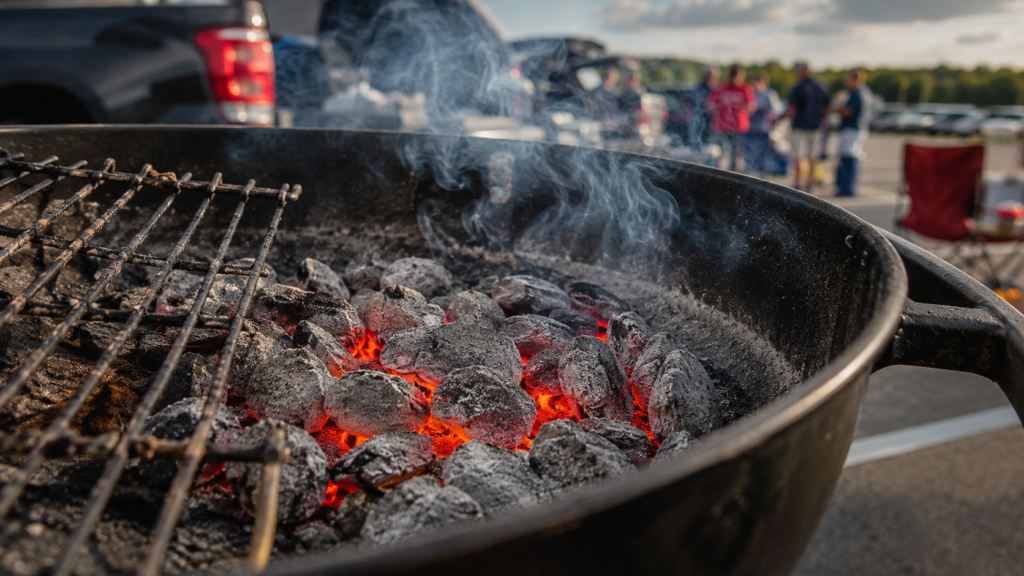
At home, there’s usually no hurry.
Finish dinner, close the vents on the charcoal grill and let everything cool overnight.
At a football tailgate, the timeline is completely different.
You may finish grilling only 45 to 60 minutes before you want to walk toward the stadium. Everything you brought into the parking lot needs to be packed, secured or disposed of according to the rules of that particular venue.
The problem is that charcoal doesn’t immediately stop producing heat just because the food is finished.
Weber’s standard shutdown procedure is to close the lid and shut the upper and lower vents, cutting off the oxygen supply to the charcoal. That’s an effective method for extinguishing charcoal, but Weber also notes that the process takes time and recommends waiting until everything is completely cool before removing ash.
That’s perfectly reasonable in your backyard.
It’s less convenient when kickoff is approaching.
How to Put Out Charcoal at a Tailgate Safely
The goal shouldn’t be to make red-hot charcoal magically cold in a few minutes.
Instead, think about your shutdown as two separate jobs:
Extinguish the charcoal.
Then:
Cool the grill.
Leaving a pile of burning charcoal inside the grill means the grill continues absorbing heat while you’re trying to pack everything else.
That’s why a purpose-built charcoal extinguisher can be useful.
A charcoal extinguisher bucket allows you to remove the remaining charcoal from an appropriate grill, place it into a heat-resistant container designed for that purpose and seal the container so oxygen can no longer support combustion.
Once the heat source is removed, the grill itself can begin cooling without a bed of hot charcoal continuing to heat it.
Important: Removing hot charcoal does not automatically make either the grill or the charcoal container safe to load into a vehicle. Both can remain dangerously hot. Always follow your grill and extinguisher manufacturer’s instructions and verify that equipment is completely safe to transport before loading it.
A Charcoal Extinguisher Bucket Is the Tailgating Tool Most People Don’t Know About
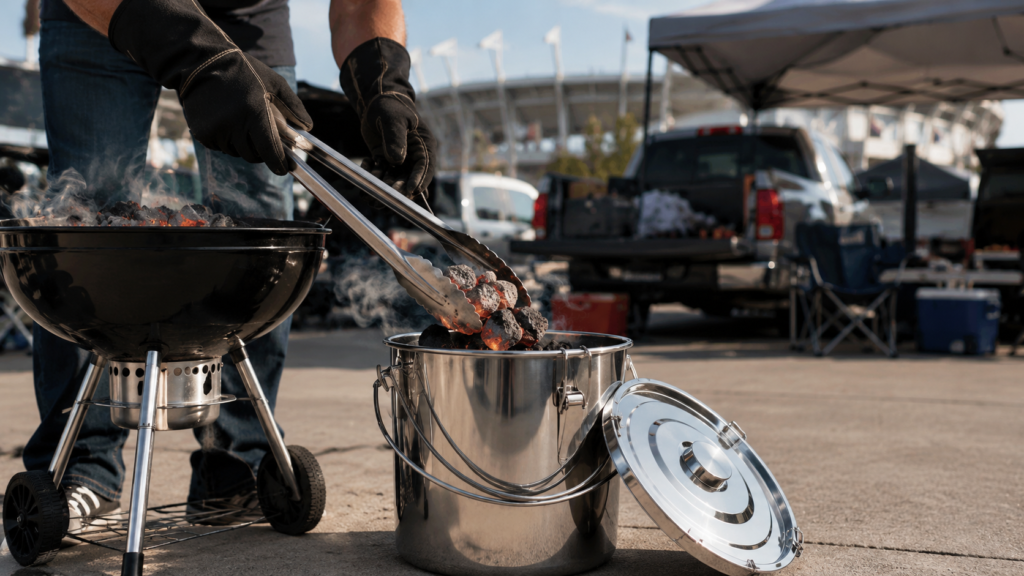
One of the most interesting solutions for this problem is a charcoal saver extinguishing bucket, traditionally called a keshizumi.
Unlike a basic plastic bucket or ordinary trash can, a proper charcoal extinguisher is specifically designed to handle hot coals.
One example is the Bincho Grill Charcoal Saver Extinguishing Bucket, a three-gallon stainless-steel container with a locking lid and airtight design.
The idea is simple.
Charcoal needs oxygen to continue burning. Put the coals into the proper container, securely close the lid, and the limited oxygen supply eventually stops combustion.
The Bincho model includes three locking latches, a carrying handle and an internal bottom grate intended to keep hot charcoal from directly contacting the bottom of the container. The manufacturer specifically markets it for hot coals and ash collection.
There’s another benefit:
You may be able to reuse the remaining charcoal later instead of wasting it.
At the time of this article, this type of charcoal saver is also available through Amazon, making it an interesting piece of gear for frequent charcoal grillers and tailgaters.
How to Shut Down Your Charcoal Grill Before Kickoff
A good tailgate shutdown actually begins before you’ve finished cooking.
Here’s the routine I’d use:
- Stop adding charcoal well before the food is finished. If you know you’re leaving the tailgate around 12:30, don’t dump another chimney of charcoal into the grill at noon. Use the remaining fire strategically.
- Finish cooking with teardown time in mind. Try to have the last food coming off the grill at least 60 to 90 minutes before you expect to leave whenever your setup allows it.
- Close the vents when cooking is finished. On grills designed for this method, shutting the intake and exhaust vents begins starving the charcoal of oxygen. Follow the shutdown instructions for your particular grill.
- Use a charcoal extinguisher only as its manufacturer directs. If your grill and charcoal container allow safe removal of the remaining coals, use heat-resistant gloves and appropriate metal tools. Never improvise with plastic containers or other containers not intended for hot charcoal.
- Place the hot extinguisher on a noncombustible outdoor surface. The Bincho manufacturer specifically warns that its extinguisher becomes very hot and says a hot bucket should be kept outdoors on stone or cement. It is not an instant “hot charcoal storage container for your SUV.”
- Allow the empty grill to cool while you pack everything else. Take down the canopy, fold chairs, clean tables and organize the vehicle while the grill is losing heat.
- Do not load hot equipment into your vehicle. A closed container may have stopped visible flames while still holding an enormous amount of heat. Never assume “fire is out” means “safe to transport.”
This method turns grill shutdown into part of your tailgate schedule rather than the last thing you think about before heading to the stadium.
Can You Pour Water on Hot Charcoal?
You can find conflicting advice about this because the correct answer depends partly on the grill.
Kingsford describes slowly adding water to charcoal while stirring as one method of cooling coals relatively quickly. It specifically warns to pour slowly because hot charcoal and water can produce dangerous steam.
Weber, however, advises against using water to cool its charcoal grills because doing so can damage the grill’s enamel coating. Weber’s recommended method is closing the vents and allowing the charcoal to extinguish by cutting off oxygen.
That’s why your grill manufacturer’s instructions should win over generic internet advice.
Dumping a large amount of water into a screaming-hot grill in the football parking lot isn’t the universal shortcut it may appear to be.
Besides steam and splashing ash, rapidly changing the temperature of some grill materials can potentially cause damage.
For tailgating, planning your shutdown earlier is usually a better strategy than waiting until the last minute and trying to flood the fire.
Can You Reuse Charcoal After Extinguishing It?
Often, yes.
Partially burned charcoal can still contain usable fuel.
Kingsford notes that partially burned charcoal can be reused after it has been completely cooled and dried.
That’s another reason a charcoal saver is an interesting product.
Instead of treating every remaining briquette or piece of lump charcoal as waste, an extinguisher that cuts off oxygen can preserve some of that fuel for another cook.
For someone who tailgates frequently during football season, reducing wasted charcoal is a nice secondary benefit.
The first benefit, however, remains managing the shutdown more safely and efficiently.
Check Your Stadium’s Tailgating Rules Before You Light the Grill
Don’t assume every football parking lot handles charcoal the same way.
Some venues permit charcoal grills but require hot coals to be placed into designated disposal containers. Others may restrict grill types, open flames, fuel storage, tailgating locations or when grilling must end.
Some University’s published tailgating policy, for example, permits charcoal and propane grills but requires hot coals to be disposed of appropriately. It also requires tailgating equipment, including grills and tents, to be removed before the game and requires a personal fire extinguisher when grilling.
That’s remarkably close to the exact problem we’re solving here.
Before game day, visit your stadium or university’s official website and check its current tailgating policy.
If the parking lot provides dedicated hot-coal disposal stations, those may be the easiest solution of all.
Build a Small Tailgate Grill Shutdown Kit
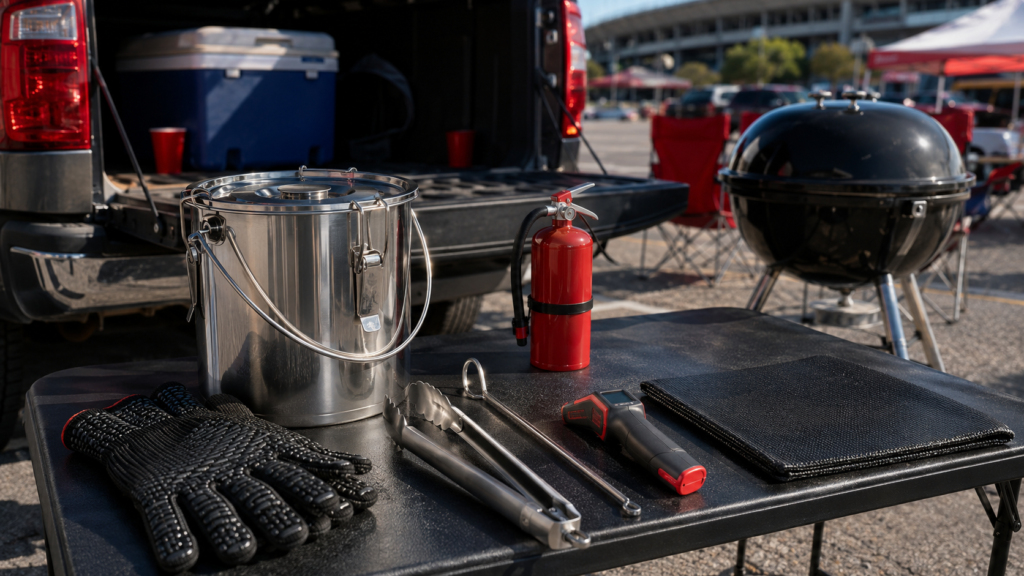
If charcoal grilling is part of your regular football routine, I’d keep a few shutdown items together with the grill.
A good setup includes a purpose-built charcoal extinguisher if appropriate for your grill, heavy heat-resistant gloves, long metal tongs or a suitable charcoal tool, an infrared thermometer for checking surface temperatures, and a properly rated fire extinguisher.
or
- Fire Resistant Gloves
- Charcoal Tongs
- Infared Thermometer
- Small Fire Extinguisher
- Charcoal Shovel
- Charcoal Extinguisher Bucket
An infrared thermometer can be particularly convenient because it lets you check the temperature of the grill exterior without touching it.
Just remember that an IR thermometer measures surface temperature. It doesn’t guarantee that charcoal hidden inside a grill or extinguisher has completely cooled.
What Type of Tailgating Grill Is Easiest to Cool Down?
If fast teardown is important, the grill you bring to the tailgate can make a big difference.
A large, heavy charcoal grill holds considerably more heat than a compact portable model. For tailgating, I prefer a grill that’s small enough to cool relatively quickly, has adjustable vents for shutting down the fire, and makes it easy to access or remove the remaining charcoal safely.
Look for features such as:
- A compact cooking chamber with less metal mass to retain heat
- Adjustable intake and exhaust vents that can be fully closed
- Easy access to the charcoal bed
- A removable ash catcher or charcoal tray
- Heat-resistant handles
- A locking lid for transportation after the grill has completely cooled
- A stable base that works well on pavement or parking-lot surfaces
The goal isn’t to find a grill that magically becomes cold as soon as cooking ends. Any charcoal grill can remain dangerously hot long after the food comes off.
Instead, a well-designed portable grill can make the shutdown process easier. Stop adding charcoal toward the end of the cook, close the vents when you’re finished, and—when appropriate for your grill—use a purpose-built charcoal extinguisher to deal with the remaining fuel separately.
That combination allows the smaller grill body to begin shedding heat while you pack the rest of your tailgate.
Need a Better Grill for Game Day?
If your current grill is bulky, difficult to transport, or takes forever to cool down, choosing a grill specifically designed for tailgating may be worth the upgrade.
I’ve compared the features that matter most for game day—including portability, cooking space, fuel type, setup, cleanup, and transportation—in my [Best Tailgating Grills Guide].
→ See the Best Tailgating Grills for Game Day
A good tailgating grill should do more than cook great food. It should also be easy to set up, easy to shut down, and easy to get back home when the game is over.
What Not to Do With Hot Charcoal at a Tailgate
Don’t dump burning charcoal onto pavement, grass, dirt or into an ordinary trash can.
Don’t put hot coals into a plastic bucket.
Don’t place a hot charcoal extinguisher directly into the back of an SUV simply because the lid is closed.
Don’t assume gray ash means there’s no heat underneath.
And don’t wait until everyone says, “Let’s head into the game,” before beginning your grill shutdown.
Charcoal can hide hot embers long after the obvious flames disappear.
The Better Tailgating Strategy: Work Backward From Kickoff
The biggest lesson here may not actually be about charcoal.
It’s about timing your cook around the game.
If kickoff is at 1:00 and you want to start walking toward the stadium at 12:30, your tailgate cooking schedule shouldn’t end at 12:25.
Finish cooking earlier.
Stop feeding the fire.
Begin shutting the grill down while everyone is still eating.
Then pack the rest of your tailgate while the grill and charcoal are cooling.
A charcoal extinguisher can make that process easier because it gives you another way to manage the remaining fuel, but it doesn’t eliminate the laws of thermodynamics.
Hot steel and hot charcoal still need time to cool.
Frequently Asked Questions
How to Put Out Charcoal at a Tailgate?
Begin by following the shutdown procedure for your grill, which commonly means closing the lid and vents to restrict oxygen. A purpose-built charcoal extinguisher may also allow appropriate hot coals to be isolated and extinguished separately. Always follow the instructions for both the grill and charcoal container.
How long does charcoal stay hot?
Charcoal can remain hot for hours, and embers buried beneath ash can stay hot much longer than they appear. Never judge charcoal only by whether you can see flames.
Can I pour water on charcoal to cool it faster?
Some charcoal manufacturers describe careful water cooling as an option, while some grill manufacturers specifically advise against using water because it can damage the grill. Follow the instructions for your particular equipment.
Can I put hot charcoal in a metal bucket?
Only use a container specifically designed and rated for hot charcoal or ash. An ordinary metal bucket should not automatically be assumed safe for this purpose.
Can I put a charcoal extinguisher in my vehicle while it’s hot?
No, a charcoal extinguisher can remain extremely hot after the charcoal has been placed inside. For example, the manufacturer of the Bincho charcoal saver instructs users to handle it with heat-resistant gloves and place it outdoors on stone or cement while hot. Let the unit cool completely according to the manufacturer’s directions before transportation.
What’s the best way to pack up a charcoal tailgate before kickoff?
Finish cooking early, stop adding fuel, begin grill shutdown well before departure, comply with the venue’s charcoal-disposal rules, allow the grill to cool while packing the rest of your equipment and never load hot grilling equipment into your vehicle.
Final Thoughts
Charcoal grilling produces some of the best food in the football parking lot. Knowing how to put out charcoal at a tailgate comes down to planning your shutdown early rather than trying to cool a blazing-hot grill at the last minute.
Unfortunately, charcoal doesn’t care what time kickoff is.
The trick isn’t trying to make a blazing-hot charcoal grill instantly cold. It’s developing a shutdown routine that starts early enough to extinguish the fuel, cool the grill and pack everything safely.
For frequent charcoal tailgaters, a charcoal saver or extinguishing bucket is one piece of gear worth knowing about. It can separate the hot-coal problem from the grill-cooling problem and may even allow you to save partially burned charcoal for another cook.
Start shutting down early, respect the heat that’s still trapped in the equipment, follow your grill and stadium rules—and you’ll spend less time staring at glowing coals while everyone else is walking toward the game.
As an Amazon Associate, Backyard Smoke Lab may earn from qualifying purchases.
🔥 Shop BSL Favorites on Amazon!
📄 Get Free BBQ Recipes, Guides & Charts
👉Check out the list of BBQ Gear I recommend and use
🔥 Follow Backyard Smoke Lab for more BBQ tips, recipes, and reviews
📺 YouTube: https://www.youtube.com/@backyardsmokelab
📸 Instagram: https://www.instagram.com/backyardsmokelab
🎵 TikTok: https://www.tiktok.com/@backyardsmoklab
🌐 Website: https://backyardsmokelab.com